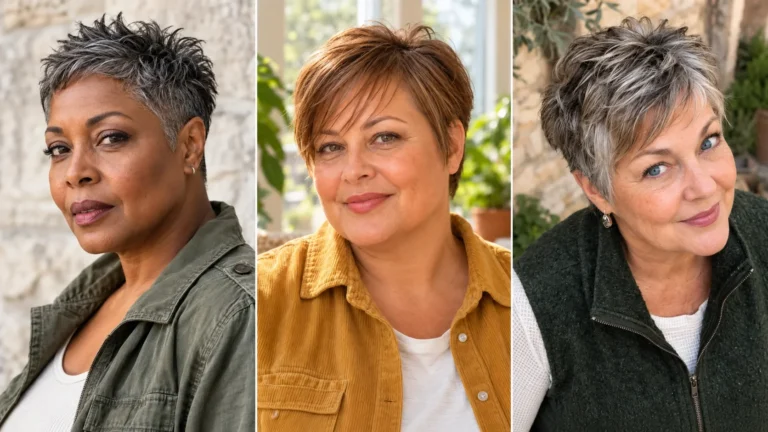
13 Layered Bob Fine Hair: Volume Without See-Through Ends
A layered bob fine hair cut goes one of two ways, and you usually find out in the car park mirror. Either the crown finally has lift and the shape swings when you turn your head, or the bottom two inches have turned into stringy little feathers you keep tucking behind your ears so nobody sees through them.
The difference is not your stylist’s talent. It is where the weight came out.
When strands are thin you have no density to spare. Standard exterior layers, the kind cut in visible steps down the outside of the shape, steal that density straight from the perimeter baseline. On thick hair nobody notices. On fine hair the baseline is the only thing standing between you and optical transparency.
The modern version works the opposite way. Weight gets carved out of internal pockets underneath, where you never see it, while the outer edge stays completely blunt. Those short interior pieces act like scaffolding and push the longer canopy up off the scalp. Cut that way, this is genuinely the best bob for volume on fine hair, and your ends stay solid.
The Fine Hair Bob Golden Rules
Protect the bottom two inches. No thinning shears, no razor, no texturizing anywhere near the perimeter baseline. That edge is your density.
Carve the weight internally. Shorter interior pieces sit underneath and hold the longer canopy away from the head. That is where visible lift actually comes from.
Point-cut with scissors, ban the razor. A razor frays the cuticle along the cut edge. On a porous fine strand that fraying travels upward and you get split ends within weeks.
Move your part an inch off centre. It forces the roots against their growth grain and gives you crown hinge lift for free, before you touch a single product.
Layered Bob vs Blunt Bob: Which Wins for Thin Hair?
This is the question that stalls most women in the consultation chair. The honest answer depends on how your strands behave, not on which photo you prefer.
Pick a blunt bob if your hair is pin straight and lies flat with no bend in it. A single solid baseline reflects light in one unbroken line, and that line is what the eye reads as a wall of hair. Among bob hairstyles thin hair responds to, nothing beats a blunt edge for raw bottom density.
Pick a layered bob if your hair has any natural wave, or if your real complaint is a flat crown rather than thin ends. Internal layers give the shape somewhere to expand into. A blunt bob on wavy fine hair often sits like a triangle, wide at the bottom and dead flat on top.
Not sure which camp you are in? How your strands hold a root mist or a texturizing powder tells you a great deal, and our hair porosity finder walks you through it in about a minute.
13 Flattering Variations of the Layered Bob for Fine Hair
Every one of these keeps the perimeter blunt. What changes is where the internal weight comes out and how the front is shaped.
Variation 01 • Everyday Lift
1. The Classic Internally Layered Bob

From the outside this reads as a solid bob. All the work happens underneath, where short interior pieces hold the top veil up and away from the scalp.
It is the safest starting point if a previous layered cut left you nervous. Nothing visible changes at the edge.
Best for: Straight to slightly wavy fine hair, any face shape
The volume trick: Interior sections cut 2 to 3 inches shorter than the canopy, invisible from the surface
Morning routine: Mousse at the roots, rough dry, done in six minutes
Salon chair script: “Keep the baseline blunt and take the weight out internally only.”
Variation 02 • Cheekbone Lift
2. The Jaw-Length French Bob With Wispy Bangs

Shorter overall, which immediately removes the weight that was dragging your roots down. The wispy fringe covers a high or thinning forehead without the heaviness of a blunt bang.
The jaw-length cut point does real work here. It lands where your face is narrowing, so it pulls the eye inward instead of out.
Best for: Oval and heart faces, fine hair that collapses by noon
The volume trick: Less length to carry means the roots stand up on their own
Morning routine: Dry the fringe first, let everything else air dry
Salon chair script: “Jaw length, blunt at the bottom, and point-cut the fringe so it stays soft.”
Variation 03 • Flat Crown Fix
3. The Inverted Graduated Stacked Bob
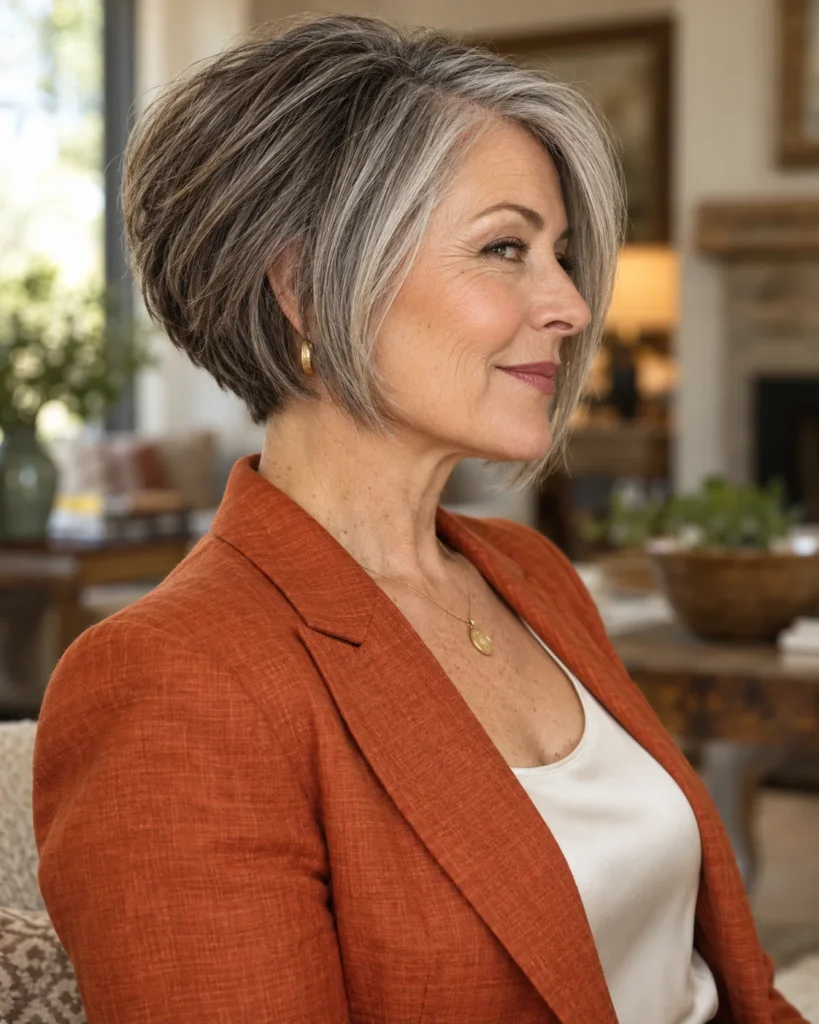
Stacked graduation at the back builds a shelf of shorter hair that physically props up everything above it. If your crown gives up an hour after styling, this is the best bob cut thinning hair at the top responds to.
The front stays longer, so you keep coverage around the face while the back does the lifting.
Best for: Flat crowns, round and square faces, hair that will not hold lift
The volume trick: Stacked graduation at the occipital bone, the widest point at the back of your head
Morning routine: Round brush the back only, leave the front alone
Salon chair script: “Graduate the back with scissors, keep my front length, no thinning shears.”
Variation 04 • Tie-It-Back Length
4. The Soft Textured Lob With Face-Framing Tiers

For women who are not ready to lose the ability to tie their hair back. The lob sits just below the collarbone and the only shaping happens at the front, in two or three soft tiers around the face.
It is also the easiest shape here to grow out, because nothing was cut into the interior that has to catch up later.
Best for: Long faces, anyone who wears their hair up several days a week
The volume trick: Face-framing tiers starting at the cheekbone, nothing shorter above it
Morning routine: Air dry, twist the front pieces back while damp
Salon chair script: “Face framing only, starting at my cheekbone. Nothing through the back.”
Variation 05 • Temple Camouflage
5. The Asymmetrical Deep-Part Bob

A deep side part pulls a block of hair across the crown and over the thinner temple on the opposite side. The asymmetrical length then makes that sweep look deliberate rather than like something you are hiding.
This one earns its keep if your part has widened over the past few years.
Best for: Widening part lines, hollow temples, square and round faces
The volume trick: The deep part creates instant root lift on the heavy side
Morning routine: Set the part while soaking wet, dry the sweep in place
Salon chair script: “Cut it to a deep side part, slightly longer on the heavy side.”
Variation 06 • Zero Heat
6. The Air-Dried Wavy Layered Bob

Most fine hair carries a faint bend that gets blow dried flat every single morning. This cut stops fighting it. The internal layers are placed to let that natural bend expand instead of hanging straight.
Less heat also means less cuticle damage, which keeps your ends looking solid for longer between cuts.
Best for: Fine hair with a natural wave, low maintenance routines
The volume trick: Layers cut to sit exactly where your wave naturally bends
Morning routine: Scrunch a light mousse into damp hair and leave it alone
Salon chair script: “Cut it dry so you can see where my wave actually sits.”
Variation 07 • Back Volume
7. The Tapered-Nape Chin Bob
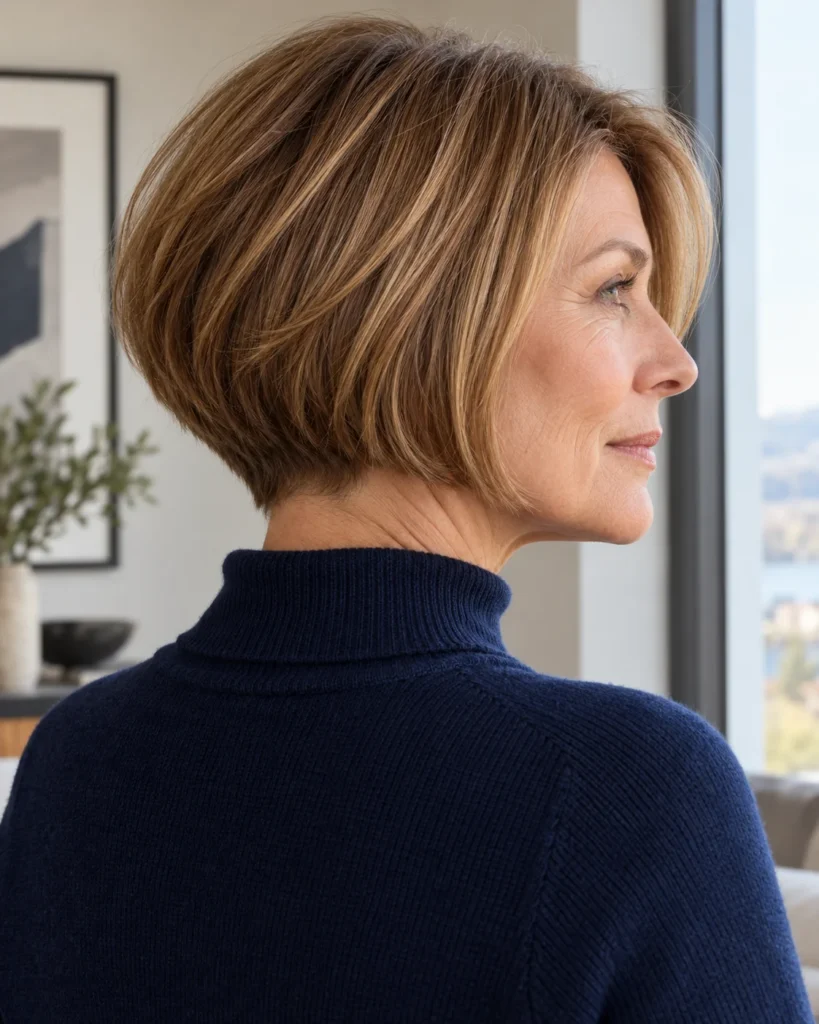
Fine hair often sits dead flat against the back of the neck, and that flatness drags the whole silhouette down. Tapering just the nape, lightly, lets the hair above it sit out instead of clinging.
The taper stays below the occipital bone and never touches the sides, so your visible perimeter is untouched. It is weight removal in the one place nobody sees.
Best for: Flat backs of the head, hair that clings to the neck, square and round faces
The volume trick: A shallow taper at the nape only, nothing above the occipital bone
Morning routine: Dry the back section first while it is wettest, flipping it outward
Salon chair script: “Taper the nape only, scissors, and leave my sides completely blunt.”
Variation 08 • Forehead Softener
8. The Curtain-Bang Layered Bob

Curtain bangs do something no other fringe does for fine hair. They borrow only a small triangle of hair from the front, then split it either side of the face, so you get face framing without losing density anywhere else.
The shortest point should land at the outer brow and the longest at the cheekbone. Cut shorter than that and fine hair simply will not fill the gap.
Best for: High foreheads, long and oval faces, anyone nervous about a full fringe
The volume trick: The bang section lifts off the forehead and takes the front roots up with it
Morning routine: Round brush the fringe backward for 20 seconds, nothing else needed
Salon chair script: “Curtain bangs starting at my outer brow, blending into my cheekbone.”
Variation 09 • Rounded Body
9. The Italian Bob

Slightly longer than a French bob and rounded rather than sharp, with the interior cut to curve under at the ends. On fine hair that curve is doing structural work, because hair bending inward takes up more visual space than hair hanging straight.
It photographs well, which is partly why it keeps trending, but the reason it suits thin hair is purely geometric.
Best for: Straight fine hair with no natural movement, oval and heart faces
The volume trick: A rounded interior line that forces the ends to curve under
Morning routine: Large round brush, roll the ends under on the final pass
Salon chair script: “An Italian bob, rounded shape, blunt ends, no visible layers outside.”
Variation 10 • Going Shorter
10. The Bixie

Halfway between a pixie and a bob, sitting at the earlobe or just below. For very fine hair this is often the honest answer, because at this length there is almost no weight left to pull the roots down.
It also covers the ears and the nape, so it feels far less exposed than a true pixie while delivering most of the same lift.
Best for: Very fine or noticeably thinning hair, oval and heart faces
The volume trick: Almost zero length means the roots have nothing weighing them down
Morning routine: Fingers, a pea of light cream, under three minutes
Salon chair script: “A bixie at earlobe length, keep the perimeter solid, no razor anywhere.”
Variation 11 • Face Slimming
11. The Micro-Graduated Bob for Round Faces

The usual advice for a round face is length, but length flattens fine hair. This solves both by using a very slight front-to-back graduation, maybe half an inch, so the front sits lower than the back.
That tiny diagonal creates a vertical line beside the cheeks, which is what actually slims rather than added length.
Best for: Round and full faces, softer jawlines, fine hair at any density
The volume trick: Height at the back from the graduation, length at the front for the slimming line
Morning routine: Lift the back with a brush, leave the front pieces falling forward
Salon chair script: “Half an inch longer at the front than the back, blunt edge all the way around.”
Variation 12 • Silver Texture
12. The Grey-Texture Layered Bob

Silver strands come in wirier and more porous than the pigmented hair around them, which means half your head behaves one way and half behaves another. Layering a mixed head evenly is why so many grey bobs end up frizzy on top and flat underneath.
The fix is to cut the silver-heavy sections slightly longer so their extra spring brings them level with everything else once dry.
Best for: Half-silver or fully grey fine hair, usually fifties and beyond
The volume trick: The wiry grey texture lifts on its own once it is not weighed down by over-layering
Morning routine: A light cream on the silver sections only, nothing on the rest
Salon chair script: “My grey sections spring up more, so cut those slightly longer and check it dry.”
Variation 13 • Transition Cut
13. The Grow-Out Layered Bob

If you are growing a short cut back out, the awkward stage is real and it lasts about five months. This shape manages it by keeping the back solid and letting the front lengthen past the jaw first, so the silhouette always looks deliberate.
Trims happen on the interior only, never the perimeter, so the length you are waiting for is never cut off.
Best for: Anyone growing out a pixie or short bob, all face shapes
The volume trick: Shorter interior keeps lift while the outside length catches up
Morning routine: Tuck the front behind one ear on the days it refuses to sit right
Salon chair script: “I am growing it out. Shape the interior only and do not touch my perimeter length.”
How to Style a Layered Bob for Fine Hair in Under 8 Minutes
Three steps, and the third is the one everybody skips.
Step 1. Lightweight root lift spray or mousse on the first inch of root only. Nothing on the mid-lengths, nothing on the ends. Product weight is what kills volume before lunch.
Step 2. Flip your head forward and rough dry the roots with your fingers to about 80 percent dry. Hydrogen bonds set as hair dries, so whichever direction the roots point at that moment is the direction they hold all day.
Step 3. Flip upright, smooth the canopy with a paddle brush, then hit the roots with 15 seconds of cold air. Cold locks the bonds in the lifted position. Skip it and your volume drops within the hour.
If midday collapse is your main complaint, there is more on cooling and setting in our volume and thickness guides. For the dermatology view on heat limits, the American Academy of Dermatology covers it in their tips for healthy hair.
What to Tell Your Stylist So You Keep Your Ends
Say this before the cape goes on, not after the first section is cut. Most salon disappointments are consultation failures rather than cutting failures.
“My hair is fine, so I need the baseline cut blunt with scissors and left solid.”
“Take the weight out internally only. I do not want visible layers on the outside.”
“Please keep thinning shears and razors away from my ends completely.”
“I would rather leave with too much weight than not enough. We can always take more off.”
That last line matters more than the rest. A cut left too heavy is a ten minute fix at your next appointment. A perimeter that has been thinned out takes eight months to grow back.
Does a Layered Bob Still Work After 50?
It works, and in some ways it works better, but the rules tighten. Silvering hair usually comes in with a wirier, more porous texture than the pigmented strands beside it, so the same head takes layers differently in different sections.
A chin to jaw length bob also lifts the eye upward, which softens a jawline that has changed shape. Length past the shoulders tends to pull the whole face down once density drops.
More on shapes for maturing texture in our hairstyles over 50 section.
Frequently Asked Questions
Does a layered bob make fine hair look thicker or thinner?
Both, depending entirely on the cutting method. Internal layers with a blunt perimeter make fine hair look thicker, because the baseline stays solid while the top gains height. Exterior layers that step down the outside remove perimeter density and make the same head of hair look thinner.
What is the best bob for volume if my hair is thin and straight?
A graduated stacked bob. Pin straight hair has no natural bend to create lift, so the volume has to be built into the cut itself. Stacked graduation at the back of the head gives you a structural shelf that holds the crown up with no styling at all.
How often does a layered bob need trimming?
Every 6 to 8 weeks for a shorter bob, and 8 to 10 weeks for a lob. The shape loses structure faster than longer cuts, because every half inch of growth shifts where the internal layers sit relative to the perimeter.
Can you have layers in a bob if you have a widening part line?
Yes, and a deep side part makes it easier rather than harder. Moving the part well off centre pulls a block of hair across the widest section of scalp. Keep the layers internal so you are not removing the very hair providing that coverage. If the widening is happening quickly or in patches, that is a conversation for a doctor rather than a stylist.
If you take one thing into the salon with you, take this. Volume on fine hair is built by what sits underneath, never by what gets removed from the edge.
A layered bob fine hair cut that respects the perimeter carries its shape for weeks and still reads as solid from across the room. The same cut with a razor through the ends looks wispy by the second wash. Same name, two completely different outcomes, and the only thing separating them is a conversation you have before anyone picks up the scissors.