The Ultimate Night Hair Care Routine for Healthy Hair: Wake Up to Frizz-Free Strands
A surprising amount of everyday hair damage happens while you sleep. Every time you roll over, your strands rub against a cotton pillowcase that soaks up moisture and roughs up the smooth outer layer of each hair.
That friction is exactly what greets you in the mirror as frizz, tangles, and snapped ends. A night hair care routine of about five minutes won’t change the texture you were born with, but it can make that texture look smoother, softer, and far easier to handle by morning.
Here’s the simple four-step routine I share with almost everyone who tells me they wake up with a frizzy halo.
Quick Reference
Perfect For: All hair types, especially frizzy, dry, or breakage-prone hair
Night Commitment: 3 to 5 minutes before bed
Core Objective: Zero morning frizz, friction prevention, and moisture retention
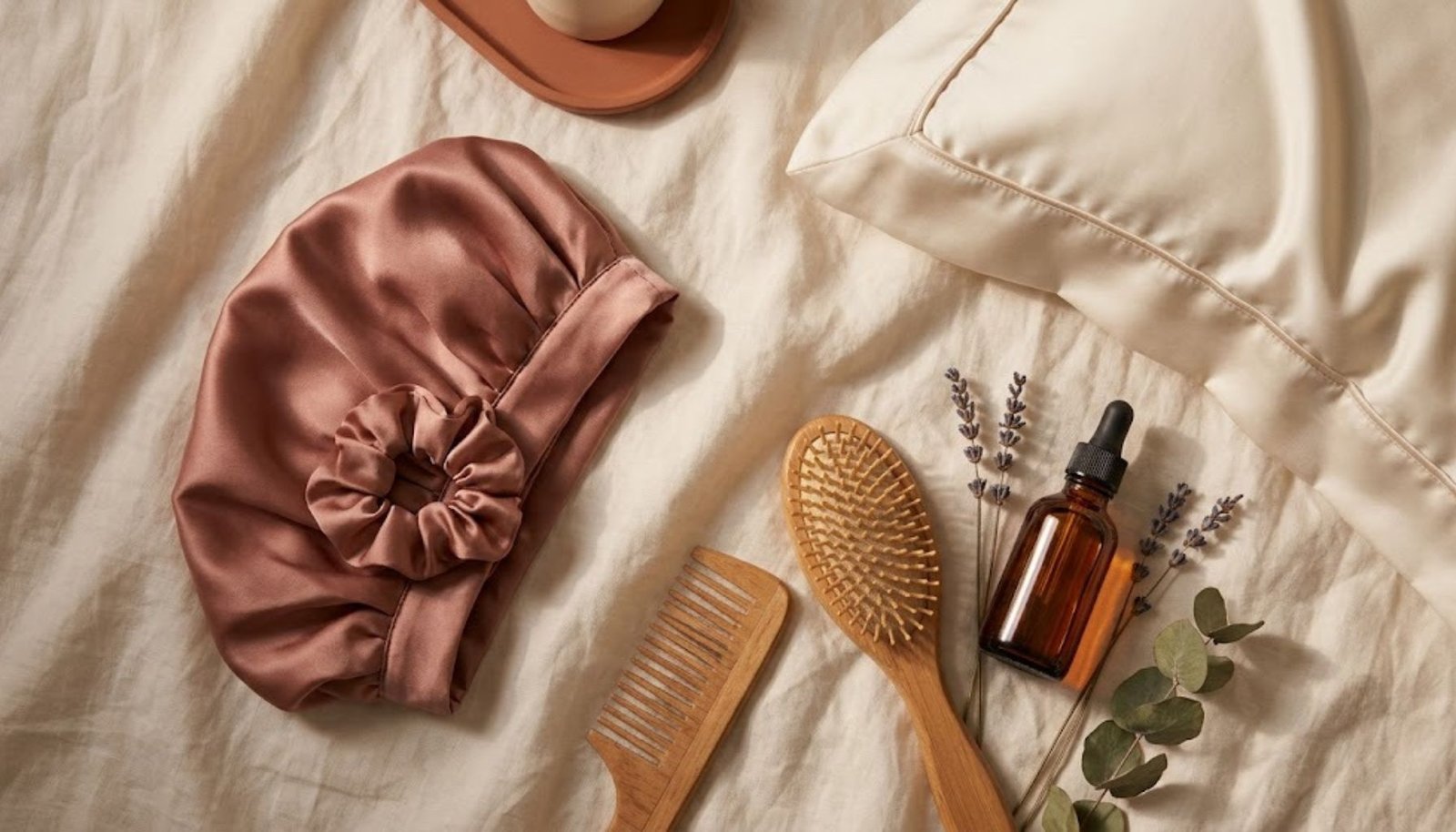
Key Tools Needed: Wide-tooth comb or wooden paddle brush, silk or satin pillowcase or bonnet, 1 to 2 drops of natural oil, silk scrunchie
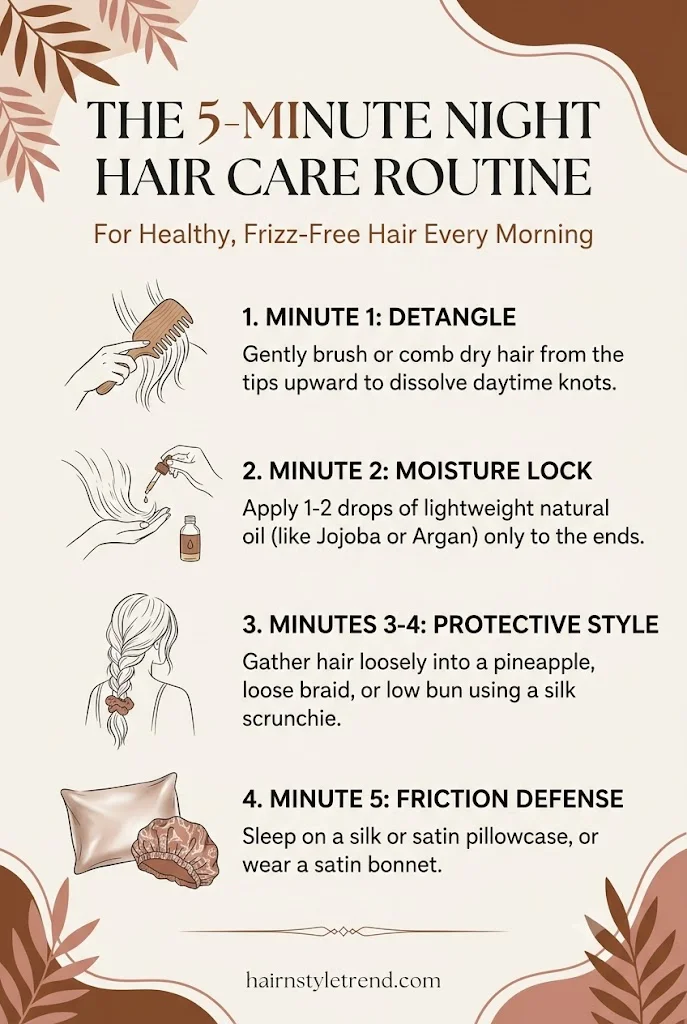
Your 5-Minute Night Timeline
Minute 1
Detangle from the tips up
Minute 2
Seal dry ends with oil
Minutes 3 to 4
Tie a loose protective style
Minute 5
Switch on friction defense
Step 1: Gentle Dry Detangling Before Bed
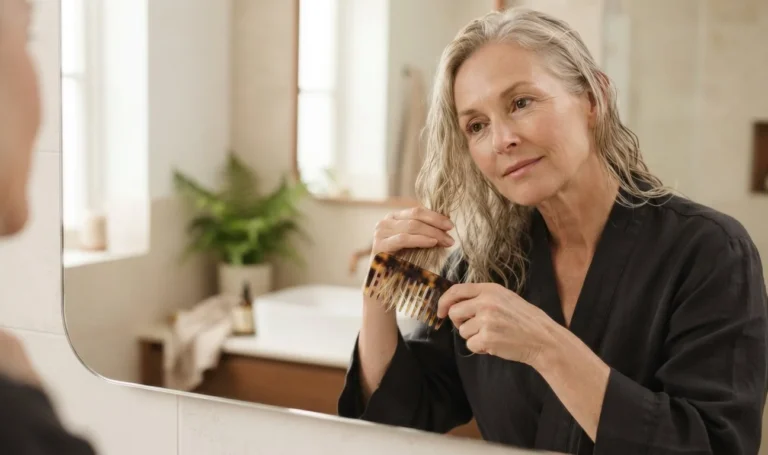
By bedtime, your hair has picked up a full day of knots from wind, scarves, bag straps, and hair ties. Leave them in, and they tighten overnight into bigger tangles that snap when you brush in a hurry the next morning.
The trick is to work from the tips upward, never from the roots down.
- Detangle on dry hair. Start with a wide-tooth comb or a wooden paddle brush.
- Hold each section. Grab your hair a few inches above the ends so any pulling stays in your hand, not at your scalp.
- Work upward. Comb out the bottom few inches first, then move up little by little.
- Use fingers on knots. If you hit a stubborn tangle, gently tease it apart with your fingers instead of forcing the brush through.
For curls and coils: Brushing curly or coily hair while dry can break up your curl pattern and leave a cloud of frizz. Finger-detangle gently or use only a wide-tooth comb, and save deeper detangling for wash day with conditioner.
Step 2: Nighttime Moisture Lock for Dry Ends
Your ends are the oldest part of your hair, so they’ve lived through the most sun, heat, and friction. A tiny amount of lightweight oil or leave-in conditioner gives them a soft coating that helps them slide against fabric instead of catching on it.
Honestly, less is more here. Piling on too much oil will just leave you with flat, greasy hair by morning.
- Warm 1 to 2 drops. Place the oil in your palm and rub your hands together to warm it. Jojoba oil suits fine or straight hair, while argan oil works nicely on wavy and curly hair.
- Apply to ends only. Smooth or scrunch it through only the last few inches of your hair, keeping it strictly away from your roots.
- Try a leave-in instead. If you prefer a leave-in conditioner, use a tiny pea-sized amount in place of oil.
Step 3: Low-Tension Protective Styling
Loose hair spreads across the pillow and gets rubbed from every direction as you move. Gathering it gently keeps strands together and cuts down how much of your hair touches the fabric.
The magic word is loose. A style that feels snug at bedtime keeps pulling on your roots and hairline for hours, so always choose comfort over neatness.
The Loose Pineapple for Wavy and Curly Hair
Flip your head forward, gather your hair at the very top of your head, and wrap one soft loop of a silk scrunchie around it. Your curls stay on top, safe from being crushed while you sleep.
The Loose Three-Strand Braid for Straight and Wavy Hair
Braid softly starting at the nape and tie the end with a small silk scrunchie. You should be able to easily slide a finger under each section.
The Low Twisted Bun for Long Hair
Twist your hair gently at the nape, coil it into a soft bun, and secure it with a silk scrunchie wrapped once or twice.
Step 4: Friction Defense with Silk and Satin
This is the step that protects all the work you just did. Silk and satin both have a smooth, slippery surface that lets hair glide as you move, which means less rubbing, less frizz, and fewer knots by morning.
- Silk pillowcases: A natural protein fiber that feels cool and breathable. They cost more, but they’re lovely if you sleep warm and prefer natural materials.
- Satin pillowcases: A smooth weave, usually made from polyester, that is budget-friendly and very easy to wash.
- Satin bonnets: A bonnet covers all your hair, not just the side touching the pillow. It’s the better pick if you toss and turn or want to keep waves and curls defined without squishing them.
Custom Adjustments by Hair Type
- Fine or straight hair: Brush lightly, tie a loose low scrunchie at the nape, and sleep on silk or satin. Skip heavy oils that leave fine hair limp.
- Wavy or curly hair: Detangle with fingers or a wide-tooth comb, put your hair in a loose pineapple with a silk scrunchie, and wear a roomy satin bonnet.
- Coily or thick hair: Section into loose protective twists or braids, seal your ends with a leave-in and a little argan oil, and cover with a satin bonnet or silk scarf.
The Never Do This at Night List
Even a perfect routine can be undone by a few sneaky habits. Keep these off your bedtime list:
- Going to bed with wet hair. Hair is at its most fragile when wet, so it stretches and snaps easily as you toss and turn. Let it dry first.
- Using rubber bands or tight elastics. They grip and dig into strands, leaving creases, weak spots, and breakage. Reach for a silk scrunchie instead.
- Sleeping with heavy styling buildup. Stiff gel, hairspray, or layers of dry shampoo make strands rough and rigid, which leads to breakage overnight. Brush it out, or rinse if it’s too heavy.
- Tying the same tight style in the same spot. Constant pulling on the same sections stresses your hairline. Keep it loose and change the placement.
Night Hair Care FAQ
Can I sleep with wet hair if I use a silk bonnet?
A silk bonnet cuts friction, but it can’t make wet hair any less fragile. Damp strands still stretch and snap easily, and a damp scalp tucked under fabric all night can feel irritated. Let your hair dry first.
Should I oil my scalp every night?
No, keep your nightly oil for your ends only. Your scalp already makes its own natural oils, and adding more every night can lead to flat roots and buildup.
What is better: a silk pillowcase or a satin bonnet?
A silk pillowcase is comfortable and works well for fine, straight, or shorter hair. A satin bonnet is better for longer, curly, or coily hair because it keeps everything contained even if you roll around. Using both is the most foolproof setup!
A good night hair care routine isn’t about expensive steps or perfect discipline. It’s about five calm minutes that protect your hair while you rest. Give it two weeks and notice how your ends feel, how much frizz meets you in the mirror, and how much easier your morning brush becomes.
Save this night routine to your Pinterest hair care board so it’s ready for tonight.