Rosemary Oil for Hair Growth: Science, Dilution & Results
Yes, there’s real science behind rosemary oil for hair growth, but it works slower and quieter than your feed makes it sound. It went viral because of a 2015 study where people with pattern thinning used either rosemary oil or 2% minoxidil for six months, and both groups ended up with a similar increase in hair count.
The rosemary group also dealt with less scalp itching than the minoxidil group. The catch? Neither group showed a meaningful change at the three-month mark, so plan on three to six months of steady use before you judge it.
Honestly, I love that study, but it’s one small trial of 100 people, and it compared rosemary to the milder 2% strength. So think of rosemary oil as a promising, gentle option, not a guaranteed miracle.
Quick Reference
Perfect For: Thinning hair, everyday hair fall, oily scalps, and early-stage androgenetic alopecia
Real Results Timeline: A minimum of 3 to 6 months of consistent use
Dilution Rule: Never use it undiluted! Mix 3 to 5 drops of rosemary essential oil per 10 ml of carrier oil
Favorite Carrier Oils: Jojoba, argan, sweet almond, or coconut
The Honest Science Behind Rosemary Oil
Researchers don’t have the full picture yet, but a few ideas keep coming up in the research. Here’s what’s going on beneath your scalp, in plain English.
How It May Work
- Better scalp circulation. Rosemary is believed to support blood flow in the tiny vessels around your follicles, and this is often linked to carnosic acid, a natural compound in the plant. The idea is that better flow helps carry oxygen and nutrients to your roots.
- Natural antioxidant defense. The rosemary plant is packed with antioxidants that help protect cells from everyday stress like pollution and sun exposure. A calmer, well-protected scalp is simply a better home for growing hair.
- A possible mild DHT blocker. DHT is the hormone that slowly shrinks follicles in pattern thinning. Early lab and animal research on rosemary leaf extract suggests it may interfere with the enzyme that makes DHT, but this hasn’t been proven on human scalps yet.
One honest note for the science lovers. Much of that lab work used rosemary leaf extract, so scientists are still figuring out exactly which compounds in the essential oil do the heavy lifting.
Setting Real Expectations
Rosemary oil can’t bring back follicles that are completely gone. If a spot has been smooth and shiny for years, no oil will sprout new hair there, and anyone promising that isn’t being straight with you.
Where it really helps is with follicles that are still alive, whether they’re growing thin, weak strands or taking a long nap in their resting phase. Its job is to strengthen and wake up the hair you already have.
The 10 ml Dilution Formula
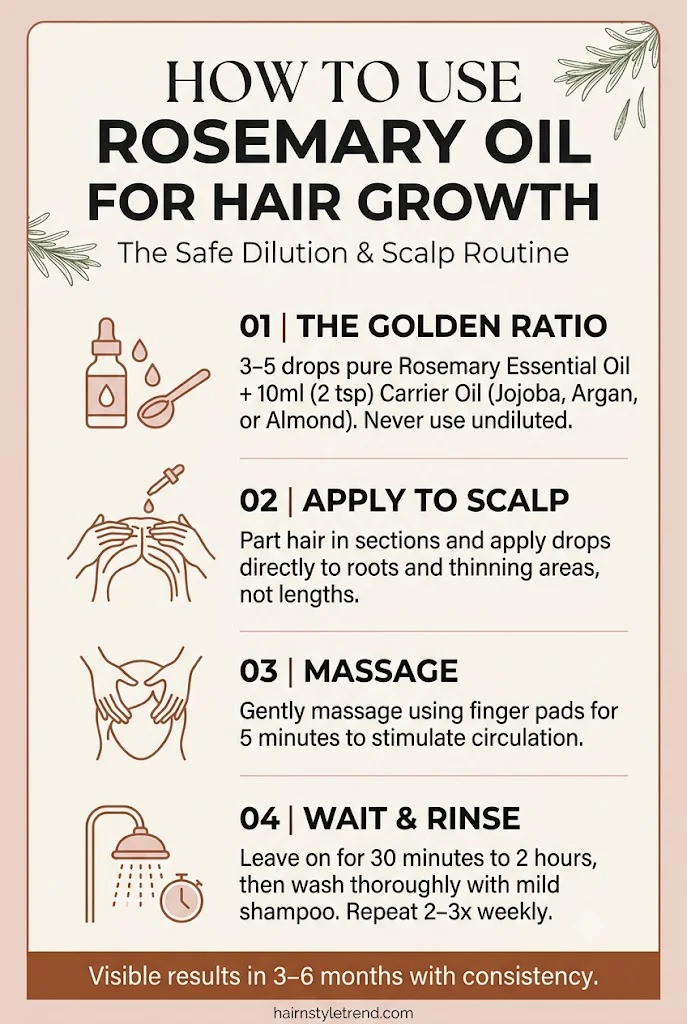
Rosemary essential oil is seriously concentrated, so it always needs a carrier oil to spread it out and protect your skin. The golden ratio is easy to remember and fits perfectly in one small amber glass dropper bottle.
The Standard 2% Dilution Ratio
3 to 5 drops
rosemary essential oil
10 ml
about 2 teaspoons of carrier oil
About 2%
a gentle blend for most scalps
Pour the carrier oil in first, add your drops, cap the bottle, and roll it between your palms to mix. New to rosemary? Start with 3 drops and work up.
Light Carriers for Fine or Oily Hair
Jojoba oil feels a lot like your scalp’s own natural oil and rinses out without a fight. Sweet almond oil is another light, silky pick, just skip it if you’re allergic to tree nuts, and pumpkin seed oil works nicely too.
Richer Carriers for Dry or Coarse Hair
Coconut and olive oil feel heavier and more cushiony, which dry or coarse hair tends to love. Coconut oil turns solid when it’s cool, so warm the bottle in your hands before using it.
Argan oil sits happily in the middle and suits most normal and wavy hair. Whatever you choose, mix small batches and store the bottle in a cool, dark spot.
Step-by-Step Massage & Application Routine
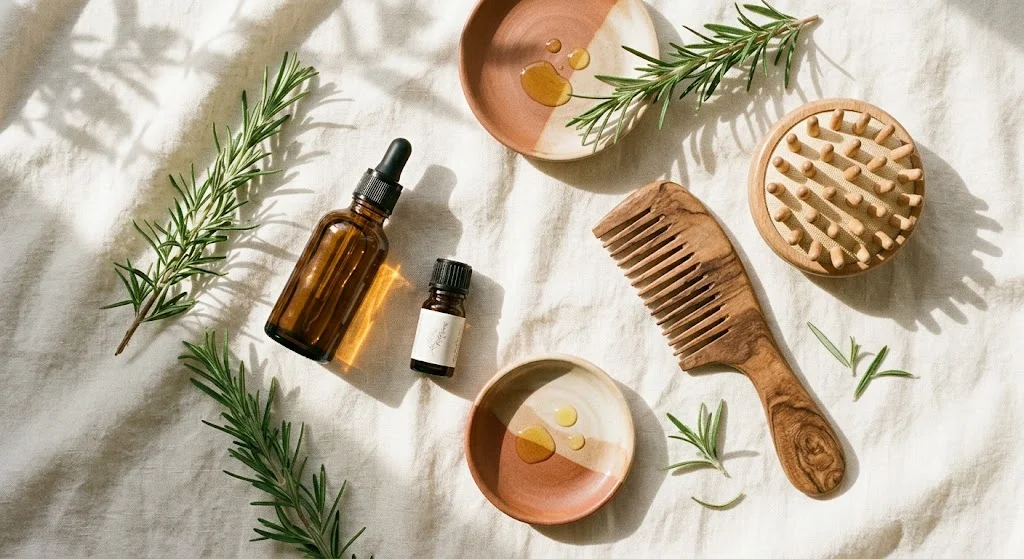
This whole routine takes about 10 minutes, and I promise the massage part is the best bit. Grab your dropper bottle, a wide-tooth comb, and a towel for your shoulders.
Step 1: Gentle Scalp Sectioning
Comb through dry hair first so your fingers won’t snag later. Then part your hair into 4 to 6 sections, clipping each one loosely out of the way.
Step 2: The Application
- Drip the blend straight along each part line with your dropper, or dab it on with your fingertips.
- Focus on your scalp, not the lengths of your hair. The roots are where the action happens.
- Start with a few drops per part and add more only where your scalp still looks dry.
Step 3: Circular Massage
- Massage for 5 to 7 minutes using the pads of your fingers, never your nails.
- Move in slow, small circles from your hairline to your crown, then down to the nape of your neck.
- A soft silicone scalp massager works too, as long as you keep the pressure gentle.
This is what gets the blood flowing to your follicles. Plus, it’s easily the most relaxing few minutes of your week.
Step 4: The Wait & Wash
- Leave the oil on for at least 30 minutes and up to 2 hours, then shampoo it out.
- Heavier carriers like coconut or olive oil may need a second round of shampoo.
- Prefer overnight? That’s fine if your patch test went well, just wash it out the next morning.
- Skip overnight sessions if you live somewhere hot and humid. Sweat plus oil sitting on your scalp for hours can leave it congested and itchy.
How Many Times a Week?
Two to three times a week is the sweet spot for most people. Consistency matters far more than drenching your scalp, so pick days you can actually stick with for months.
Important Side Effects & Precautions
Natural doesn’t automatically mean gentle. Rosemary essential oil is potent stuff, so please read this part before your first session.
Before You Start
✓ Always patch test first. Dab a little diluted blend behind your ear or inside your elbow and wait 24 to 48 hours. A light, cool tingle is normal, but redness, burning, or itching that won’t settle means this blend isn’t for you.
✓ Never apply it undiluted. Straight essential oil can cause strong skin sensitivity, blistering, and burn-like reactions on your scalp.
✓ Check with your doctor first if you’re pregnant or breastfeeding, have a sensitive scalp or a skin condition like eczema, or have a history of seizures.
✓ Keep it away from your eyes and off young children’s scalps unless a pediatrician says it’s okay.
✓ See a dermatologist if your hair loss is sudden, patchy, or painful, and don’t swap out a prescribed treatment without talking to your doctor.
Visible Results Timeline: What to Expect
Here are the checkpoints to watch for as you go. Everyone moves at their own pace, so treat these as gentle signposts, not deadlines.
Weeks 1 to 2
Your scalp starts to feel less dry, tight, and flaky after each massage.
Weeks 3 to 4
Some people notice a little less hair on their brush and in the shower drain.
Weeks 8 to 12
Tiny, soft baby hairs may pop up along your hairline or part.
Months 3 to 6
Noticeable improvements in density, thickness, and overall volume.
Quick reality check: in that 2015 study, hair count changes only became clear at six months. Snap a photo of your part once a month in the same light, because slow progress is easy to miss in the mirror.
Rosemary Oil FAQ
Can I leave rosemary oil in my hair overnight?
You can, as long as it’s properly diluted, your patch test went smoothly, and your nights aren’t hot and sticky. Lay an old towel over your pillow since oil can stain, and wash it out the next morning.
Can I add it directly to my shampoo?
Yes, and it’s the easiest way to sneak rosemary into your routine. Add about 2 to 3 drops per ounce of shampoo, which is roughly 30 ml, shake well before each use, and let the lather sit on your scalp for 2 to 3 minutes.
Just know it’s a lighter boost than an oil treatment, because it rinses away so quickly.
Will it make my hair oily?
Rosemary essential oil itself isn’t greasy at all. It’s the carrier oil that adds the slip, so a light option like jojoba plus a good shampoo keeps things fresh.
Keep the blend on your scalp instead of your lengths, and give heavier carriers a double wash. Do that and you shouldn’t see any leftover grease.
Rosemary oil for hair growth works best when you treat it like a slow, steady habit instead of a quick fix. Mix your blend, massage it in a few times a week, take your monthly photos, and give your scalp the patience it deserves.
Save this rosemary routine to your Pinterest hair growth board so your next scalp session is just a tap away.