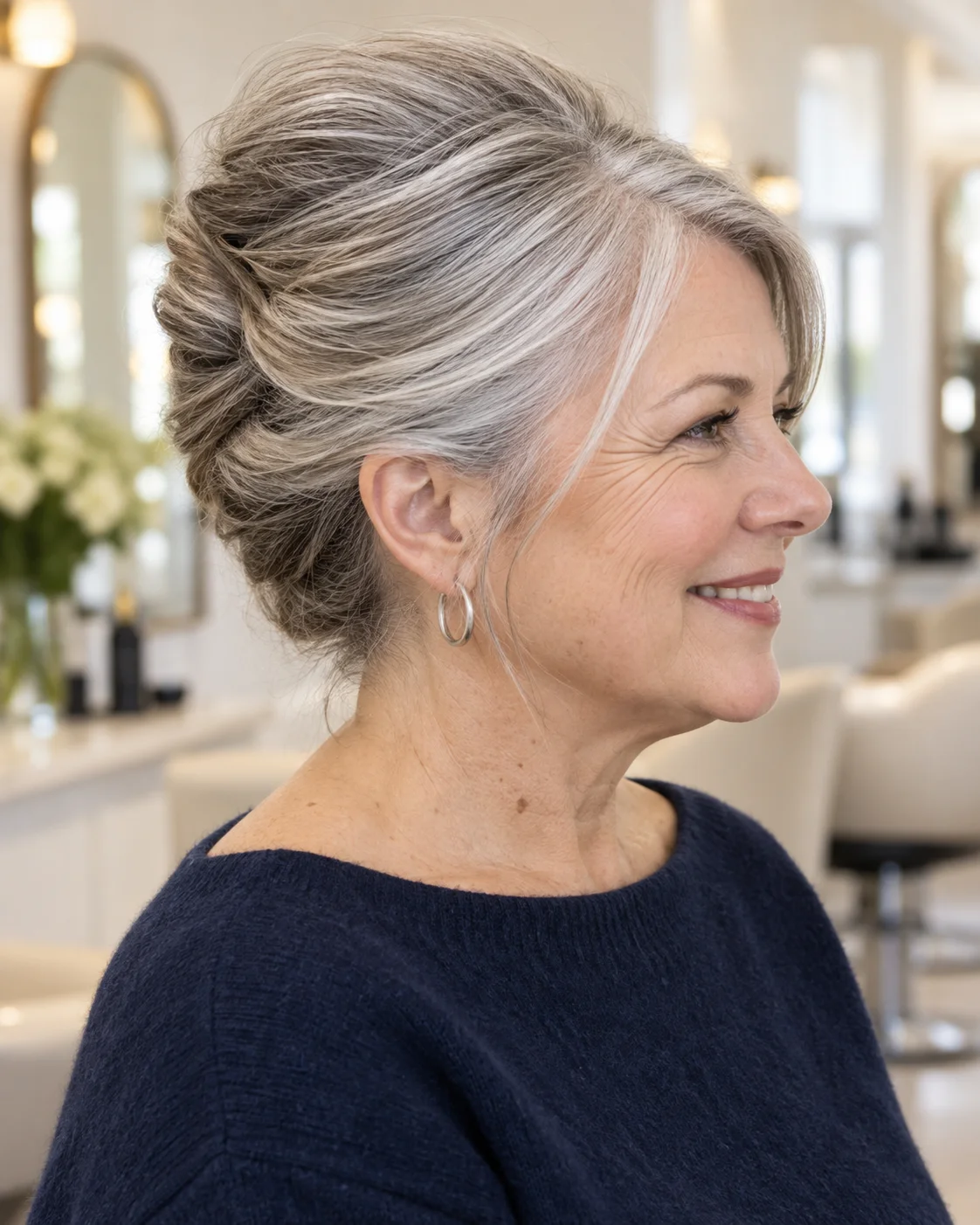
6 French Twist Ideas for Short, Fine Hair That Actually Hold
Every French twist tutorial online is filmed on someone with thick, coarse, waist-length hair. She gathers it, rolls it once, slides in two pins, and it holds. You try the same thing on a bob, and the pins slide straight out while half your nape escapes before you’ve even put the second one in.
It isn’t you. Short hair has no length to wrap, and fine hair has no grip for a pin to bite into. A traditional sleek roll needs both.
What works instead is a different set of techniques entirely. Texture instead of smoothness, an anchor instead of hope, and a deliberately relaxed finish rather than a polished one. Six of them are below, each suited to a different length and occasion.
6 French Twist Ideas for Short, Fine Hair
1. The Claw Clip Twist

Everyday, in about 60 seconds
Gather your hair as though you’re making a low ponytail, twist it once, fold it upward against your head, and lock the fold with a flat French claw clip through the middle.
Don’t try to hide the ends. Let them fan out over the top of the clip. That spray of ends is what makes the back look full rather than like a small, thin knot, and it’s exactly why this version suits short hair.
Best for: Chin to jaw-length bobs
Holds: All day
2. The Half-Up Twist
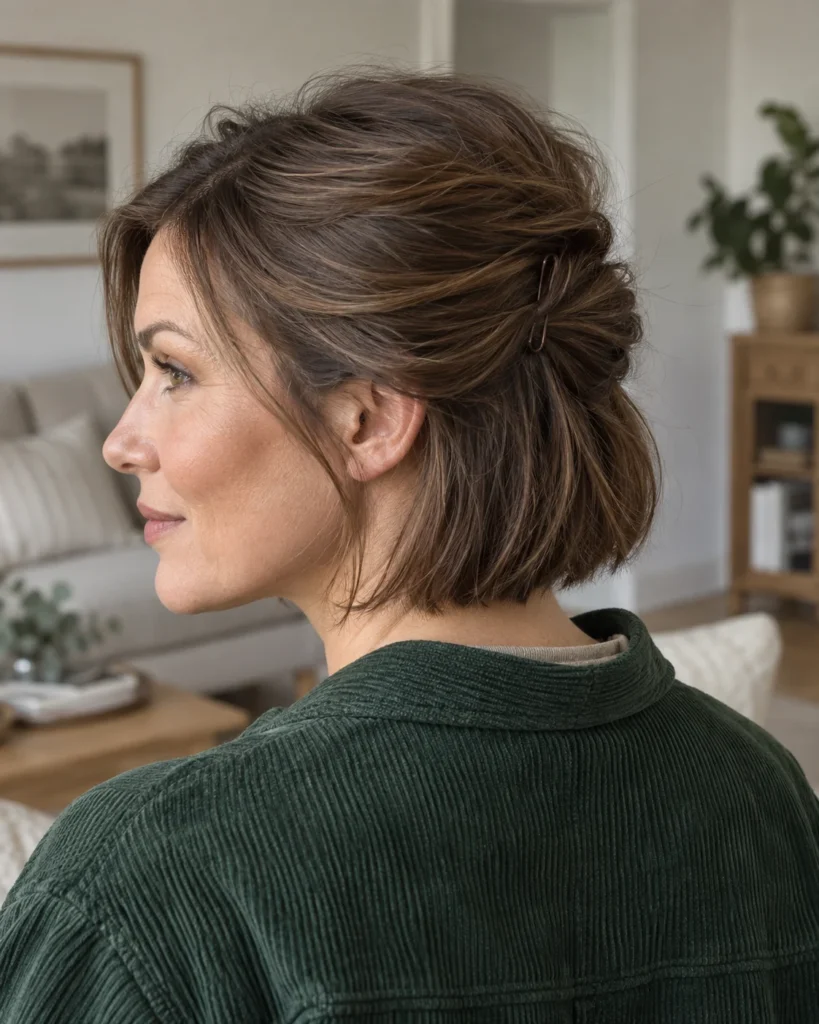
When your hair is too short for a full updo
If your nape won’t reach into a twist no matter how you angle it, stop trying to include it. Take only the section above your ears, twist that, and anchor it at the back with U-pins. Everything below stays loose.
You get the shape of an updo with none of the fighting, and the loose hair underneath frames your neck instead of poking out of a roll that couldn’t contain it.
Best for: Pixie-bobs and layered short cuts
Holds: No slippage, since there is less weight pulling on the pins
3. The Bouffant Crown Twist
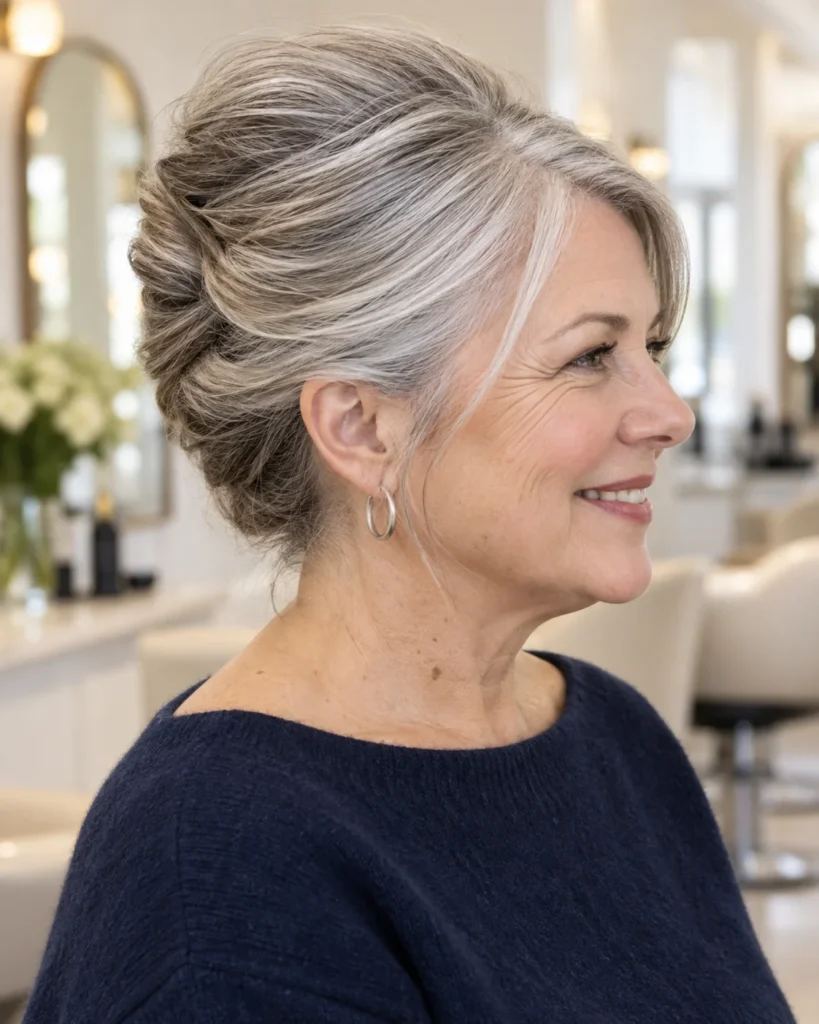
The elegant one
Before you twist anything, work a little texturizing powder into the crown and backcomb gently at the roots. Then twist as normal, overlapping the side panels softly and tucking them at the nape.
Flat roots are what make a mature updo look severe. A soft rise at the crown changes the whole profile, and on fine hair it’s the difference between looking styled and looking scraped back.
Best for: Mature hair and round face shapes
Holds: Eight hours or more of lift
4. The Micro-Elastic Anchor
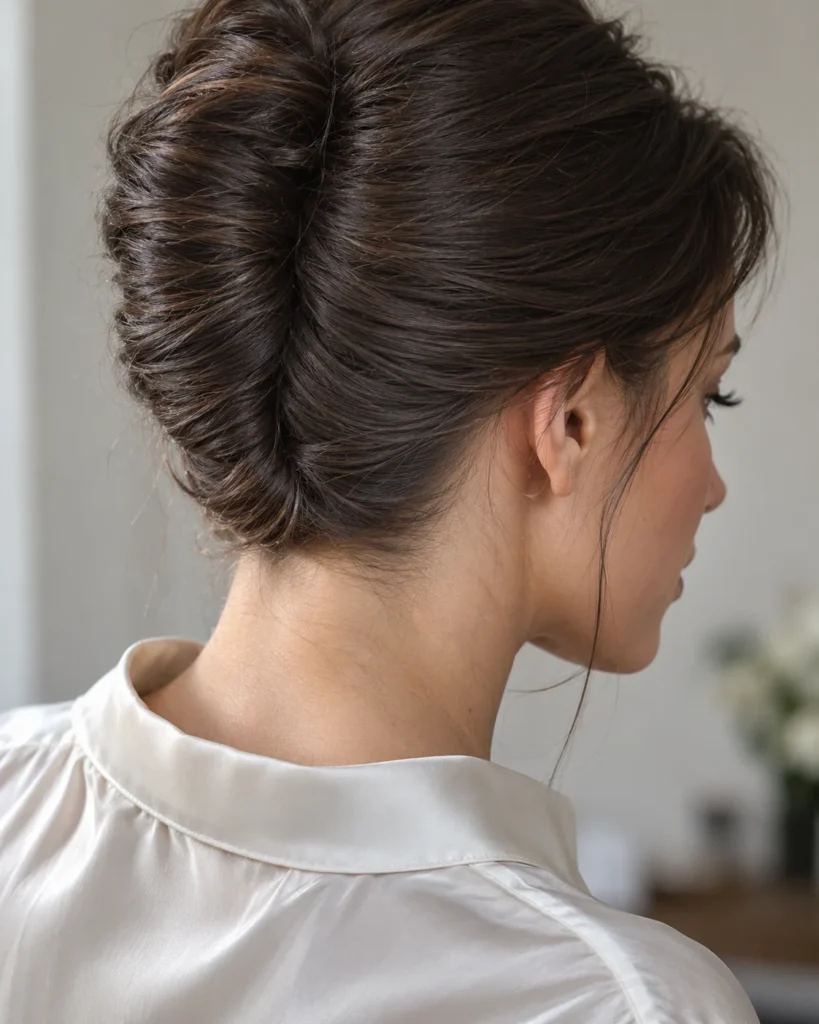
For hair that pins refuse to grip
Start with a loose low ponytail held by a clear mini elastic. Fold the ponytail up into a vertical loop, then push your pins into the base of the elastic rather than into the hair itself.
This is the fix for glass-smooth strands. The elastic gives the pins something solid to bite into, and once they’re seated there they stop migrating outward over the course of the day.
Best for: Slippery, glass-smooth hair
Holds: The most secure option here
5. The Hair Fork Twist

The French-girl version
No bobby pins at all. Twist the hair once, catch the twist with a two-prong fork entering from the right, then flip the fork 180 degrees and slide it back along your scalp to the left.
The flip is what locks it. Done properly, one fork holds more reliably than six pins, and a tortoiseshell or metal fork reads as a deliberate accessory rather than something you’re hiding.
Best for: Collarbone lobs
Holds: Four to six hours, and it needs dry texture to grip
6. The Soft Tendril Twist

For a wedding or an evening out
Build the twist tight and neat, then deliberately pull two or three fine pieces loose at your hairline and temples. Give each one a soft bend with a flat iron.
Those tendrils do more than soften your face. They draw the eye to the front, which is exactly where you want it when the density at the back isn’t what it used to be.
Best for: Holiday dinners and special occasions
Holds: High, once you’ve set it with a light hairspray
Whether any of these hold depends partly on how slippery your strands are. Low porosity hair repels product and slides loose, so it needs a matte, gritty texture rather than a foam that sits on the surface. Check yours with our Hair Porosity Finder before you decide what to reach for.
The 4-Step Anchor That Doesn’t Slip
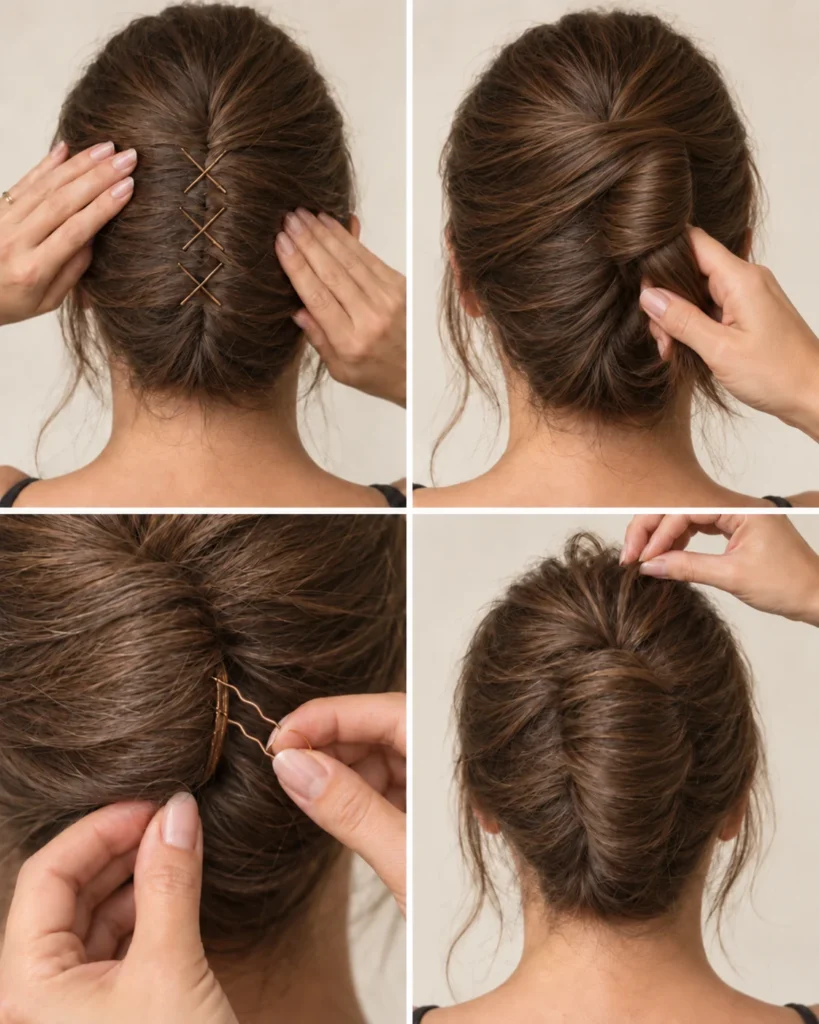
Whichever style you pick, the twist itself holds the same way. This is the technique that turns a twist from something you reset twice a day into something you forget about.
Step 1: Build the pin wall
Sweep all the hair from the left side across to the back, and interlock three bobby pins vertically down the center of your head in a crossing pattern. These pins are the foundation, and nothing else in the style works without them.
Step 2: Fold inward over your thumb
Take the right section, wrap it around your thumb, and fold it inward over the pins you just placed. Tuck the ends down inside the roll as you go rather than leaving them loose at the top.
Step 3: Lock with a U-pin
Push a crinkled U-pin in through the outer seam of the twist, rotate it 180 degrees, then drive it down into the base pins. The two sets hook into each other, which is what stops the whole thing loosening.
Step 4: Pinch the crown
Once it’s secure, pull three small sections at the crown upward by about a centimeter with your fingertips. A twist with a flat top reads as severe, and this one movement fixes it.
One thing worth knowing: a twist sits better on a cut with a solid perimeter than on one that’s been heavily thinned at the ends. If yours never seems to hold its shape, the cut may be the reason, and our haircuts for fine hair guides explain what to ask for.
Frequently Asked Questions
What do I do about the short pieces at my nape?
Stop trying to force them into the twist, because they’ll work loose within the hour anyway. Pin them upward with a small bobby pin in a color close to your hair, or catch them with a mini claw clip.
Either way they end up sitting underneath the fold of the twist, where nobody sees them.
How do I get grip in silky hair without wrecking it?
Work on second-day hair. Freshly washed fine hair is at its most slippery, and no amount of pinning changes that.
If you have to do it on clean hair, work a little dry shampoo or a rice starch texturizing powder through the mid-lengths first. Skip oils and serums entirely, since they undo the grip you’re trying to build.
Which pins actually work on fine hair?
Bobby pins for the foundation wall, and crinkled U-pins for locking the twist itself. The crinkles matter, because a smooth U-pin has nothing to catch on.
Buy them in a color that matches your hair rather than black by default, and open them with the wavy side against your scalp so they grip rather than slide.
Can I really do a French twist on a chin-length bob?
Yes, with the claw clip version or the half-up. A traditional rolled twist needs enough length to fold back on itself, which a chin bob doesn’t have.
What it does have is enough hair to twist once and clip, and the loose ends fanning over the top are a feature rather than a failure.
Final Thoughts
The goal with short fine hair was never the smooth bridal roll you see in tutorials. That shape needs density you don’t have, and chasing it is why the whole thing feels like a fight.
Aim for the relaxed version instead. A little height at the crown, a couple of pieces left loose at the front, and an anchor that actually holds. Pick the one of the six that suits your length, and give it three attempts before you decide whether it works. For more ways to build body into fine hair, our volume and thickness guides are worth a look.