Velcro Rollers for Fine Hair: How to Get All-Day Root Lift
You bought the pack after watching someone unroll three rollers and shake out a perfect blowout in fifteen seconds. Then you tried it, spent ten minutes untangling one from your crown, and watched whatever lift survived collapse before lunch.
Here’s what those videos never mention. Velcro rollers don’t curl hair. They hold warm hair in a lifted position while it cools, and the cooling is the entire mechanism.
The other thing nobody says out loud is that rolling your whole head is a trap when your hair is fine. Weight sitting around your ears widens the silhouette, a full set reads as rounded and dated, and you’ve spent forty minutes to look like you tried too hard.
Placement is what changes the result. Below are five setups built for specific haircuts and face shapes, each using between one and three rollers. Pick the one that matches your cut rather than doing all five.
Before You Get Started
- Skip oils, serums, and silicone creams completely. They coat fine strands and flatten the lift before you begin.
- Keep a few duckbill clips within reach. Velcro alone slips on very fine hair.
- Have a dry texture spray or root powder ready for the shake-out at the end.
- Work on hair that is fully dry. Damp hair catches in the hooks and snaps.
5 Velcro Roller Placement Setups for Fine Hair
1. The Mohawk Trio
The morning express
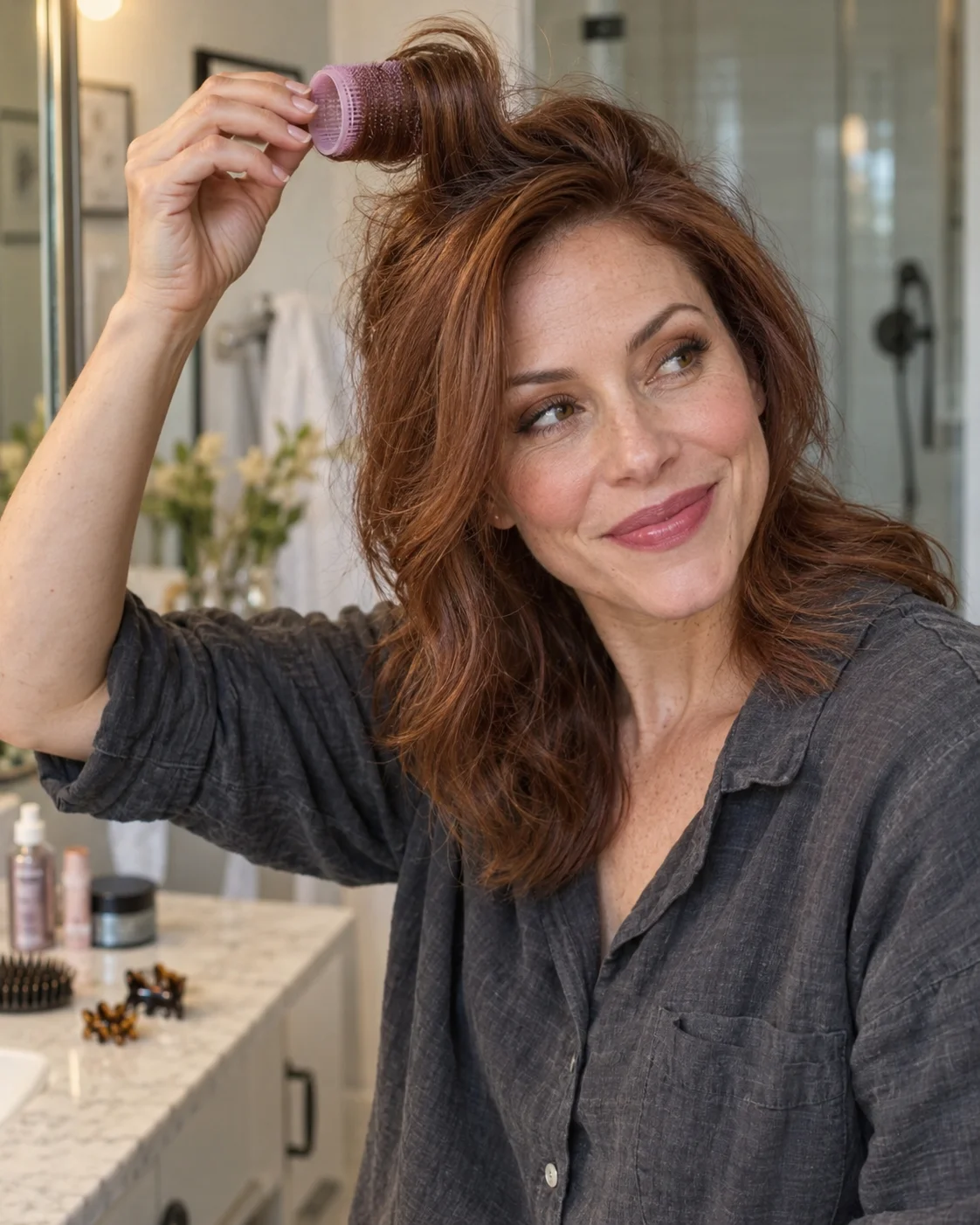
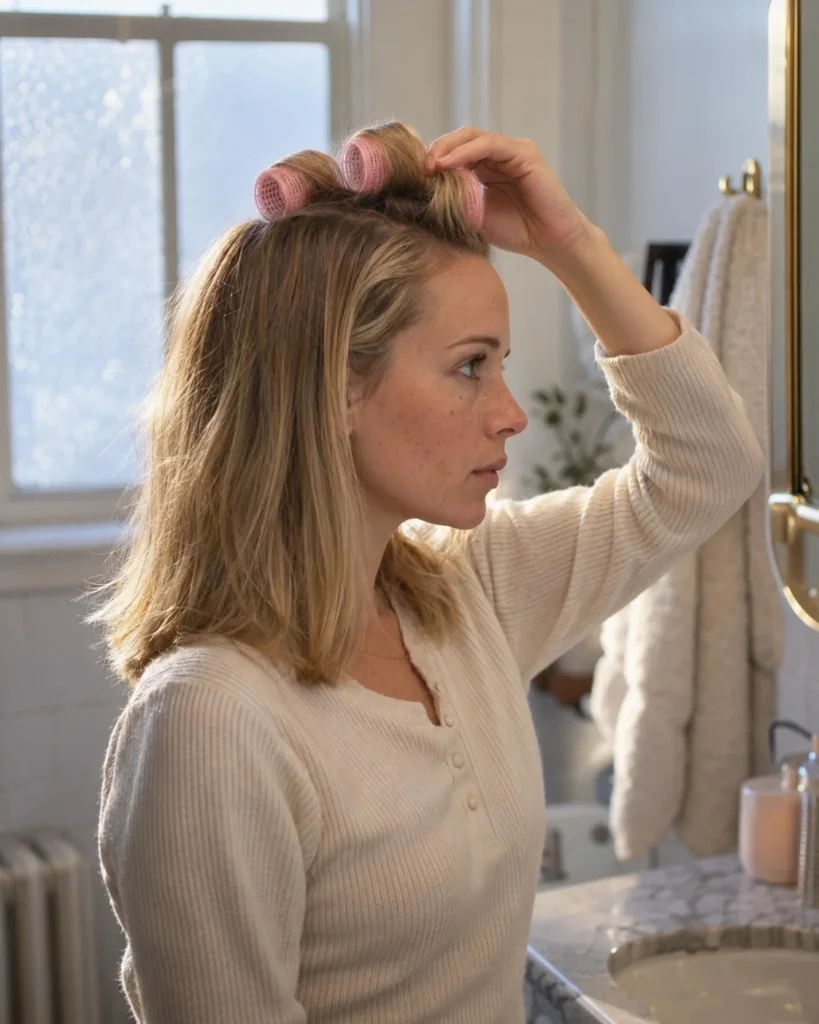
Three medium rollers in a straight line running from your front hairline back to your crown, every one rolled backward away from your face. The sides stay untouched, which keeps the silhouette narrow while the top gains height.
This is the one to start with. Three rollers is the smallest number that still gives you a continuous lifted ridge rather than one isolated bump sitting in the middle of your head.
Rollers needed: 3 medium, around 1.5 inches
Best for: Flat roots and fine shoulder-length hair
Skip it if: Your hair is shorter than chin length, since there isn’t enough to wrap
2. The Curtain Bangs Forward Roll

Face-framing flow
Rather than rolling backward, pull your fringe straight forward toward the mirror and roll it under on a jumbo barrel. When you release it, the hair sweeps back and outward across your cheekbones instead of sitting flat on your forehead.
The jumbo size is doing real work here. Anything smaller puts a visible bend in the fringe, and a fringe with a curl in it looks set rather than soft.
Rollers needed: 1 jumbo, 2.25 to 2.5 inches
Best for: Curtain bangs, bobs, and a fringe that goes limp by mid-morning
Skip it if: You wear a blunt heavy fringe, which needs to lie flat rather than sweep
3. The Diagonal Part Lift
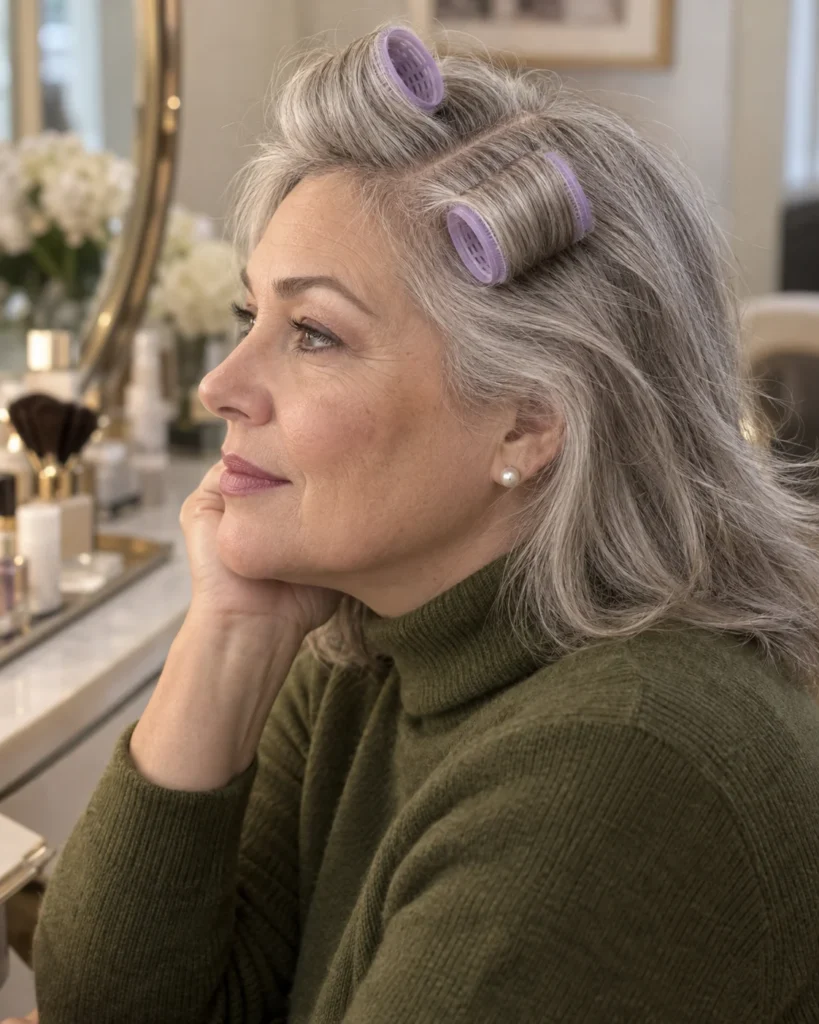
Built for over 50 and round faces
Two rollers set at roughly 45 degrees along your side part rather than straight back. The diagonal lifts the heavy side of the part where fine hair collapses first, and it breaks up the horizontal symmetry that makes a round face read as wide.
Place the first roller right at the part line, where scalp shows through most, and the second just behind it. That’s where the lift buys you the most coverage.
Rollers needed: 2 medium, around 1.75 inches
Best for: Mature hair, round faces, and widening part lines
Skip it if: You wear a middle part, since the diagonal needs a side part to work against
4. The Under and Flick Bob Setup

The French girl flick
One medium roller on top for root height, plus two small rollers placed vertically at either side of your jaw and rolled outward. You get lift at the crown and a soft flick at the ends, while the blunt bottom line stays exactly as it was cut.
Vertical placement is the detail people miss. Rolled horizontally, those same two rollers build width at your cheeks, which is the last thing a bob needs.
Rollers needed: 1 medium plus 2 small
Best for: French bobs and blunt chin-length cuts
Skip it if: Your ends are already wispy, because a flick draws the eye straight to them
5. The Cross-Over Crown
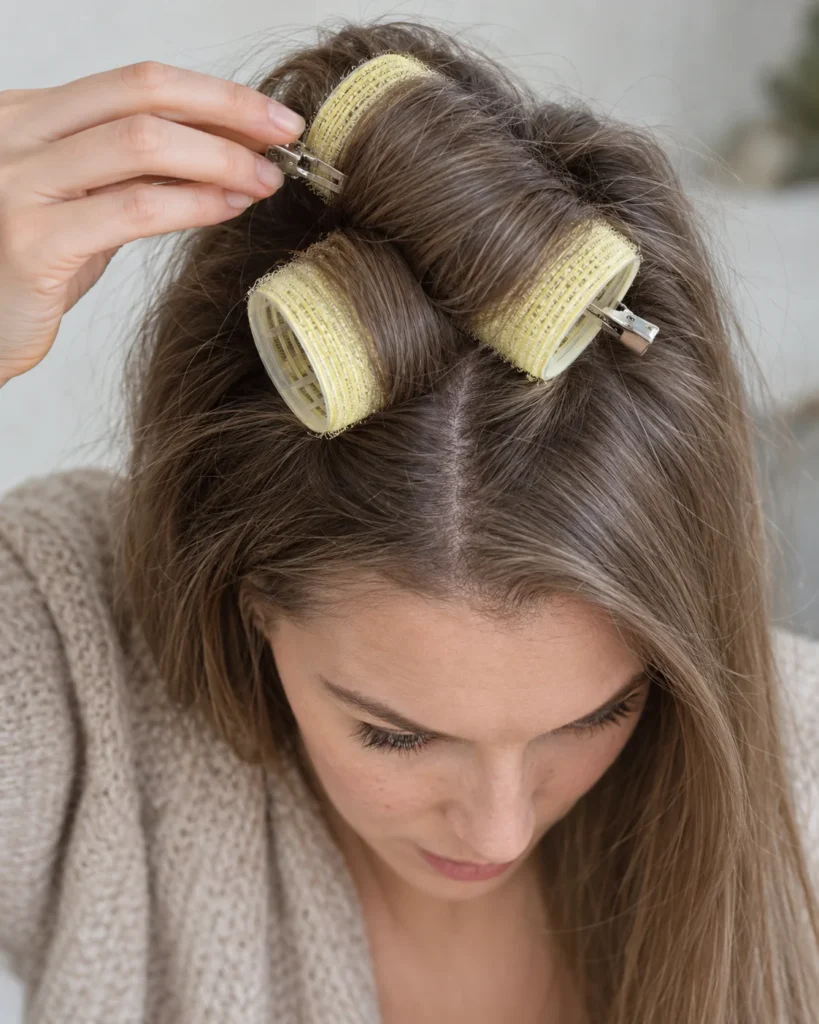
Maximum bounce
Take two crown sections and roll them so the rollers sit across each other in a rough X rather than side by side. Because the two sets of roots end up leaning in opposing directions, neither one can collapse the way a whole row falling the same way does.
It’s fiddlier than the Mohawk Trio, and worth the extra minute only if your hair is the type that looks great at nine and flat by noon.
Rollers needed: 2 medium, around 1.5 inches
Best for: Very sleek, glassy hair that flattens quickly
Skip it if: You’re in a rush, since crossed sections take longer to unwind cleanly
Whether a setup holds for ten hours or thirty minutes depends partly on your cuticle. Low porosity hair repels product and slides straight out of the rollers, so it needs a different prep than hair that soaks everything up. Check yours with our Hair Porosity Finder before you decide between a light mousse and a dry grip powder.
Key Rules for Fine Strands
- Velcro rollers set a shape, they don’t create curl. The lift comes from hair cooling in a lifted position.
- Always roll onto hair that is completely dry and still warm from the dryer. Damp hair snags in the hooks and breaks.
- Medium rollers, roughly 1.5 to 1.75 inches, are the sweet spot for fine crown hair. Giant 3-inch barrels give almost no tension.
- Overdirect each section forward and upward before rolling, or the roller sits flat instead of lifting the root.
- Unwind by rotating the roller backward like a ribbon, never by dragging it down.
Why Overdirection Is the Part Everyone Skips
Overdirect past 90 degrees
Roll a section straight down from where it grows and the roller ends up resting on your scalp. You’ve set the mid-lengths and left the root exactly as flat as it was.
Pull the section forward and upward first, past ninety degrees from your head, then roll down to the base. Now the root is held standing away from your scalp, which is the position you want it to cool in.
Dry, but still warm
Wet hair stretches and snaps inside the hooks, so fine hair has to be dry to release cleanly. It also has to be warm, because warm hair is pliable enough to take a new shape and cold hair simply isn’t.
Cool it completely
Hair sets at whatever angle it cools at, which is the whole reason any of this works. Leave the rollers in for 10 to 12 minutes, then press the hair through the roller with your fingertips and make sure it’s properly cold before you unwind.
Short on time: the cool shot button does the same job. Aim cool air at the rollers for 30 seconds and the set holds almost as well as a full ten-minute cooldown.
The 5-Minute Morning Routine
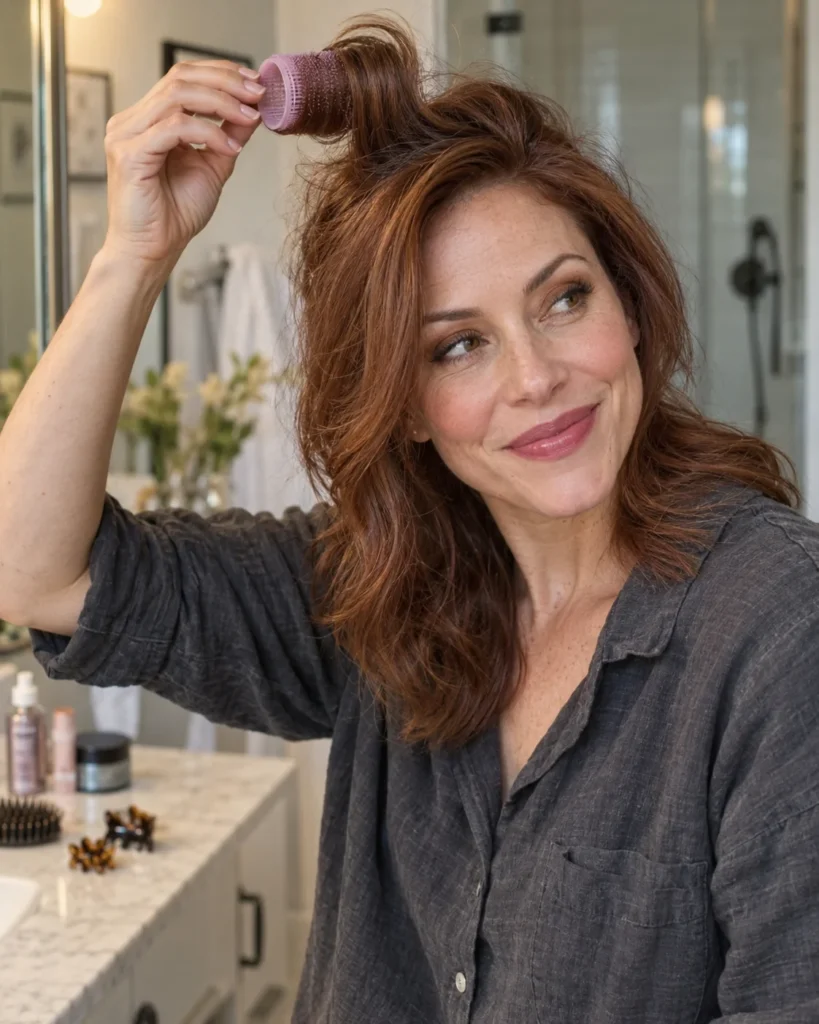
Step 1: Prep with weightless grip
Work a light volumizing mousse or root spray into damp roots only, never the lengths. A pea-sized amount is plenty, and anything heavier cancels out the lift before you start.
Step 2: Blow-dry upward and keep it warm
Dry the crown section upward with your fingers or a vent brush. Aim the last ten seconds of warm air at the exact section you’re about to roll, so the strand is warm when the roller goes on.
Step 3: Roll and clip
Take a section no wider than the roller itself. Pull it forward and up, tuck the ends smooth against the barrel, roll down to the scalp, then anchor it with a duckbill clip so it can’t wobble loose.
Step 4: Walk away for 10 minutes
Do your makeup, make coffee, get dressed. This hands-free window is the step that actually builds the lift, and it’s the one everybody rushes.
Step 5: Unwind backward and shake
Rotate the roller backward out of the hair rather than pulling it down. Shake the roots out with your fingertips and a puff of dry texture spray. If your ends still look sparse, that’s the cut rather than the styling, and our haircuts for fine hair guides explain what to ask for.
Frequently Asked Questions
Why do velcro rollers tangle in fine hair?
Almost always one of two things. Either the section is wider than the roller, so the hair at the edges wraps around the exposed ends and catches, or the ends weren’t smoothed flat before you started rolling.
Take narrower sections, tuck the ends against the barrel with your fingers first, and release by rotating backward. If one does get properly stuck, spray it with a little detangler and unwind slowly rather than pulling.
Why does my volume collapse within an hour?
You either unwound them while the hair inside was still warm, or you used something moisturizing beforehand. Fine hair holds a set only when the strand is completely cool and completely free of oil or cream.
Check the hair through the roller with your fingers before you unwind, and keep everything matte. Our volume and thickness guide covers which products to reach for.
Should women over 50 use jumbo rollers?
Only on the fringe, as in Setup 2. For crown height, medium rollers around 1.5 inches give far better tension on aging or silver textures, which tend to be coarser and more resistant than they used to be.
For cut ideas that work alongside this, browse our hairstyles over 50 section.
Can daily use cause breakage?
Pulling them out roughly will, because velcro grips fine hair hard and friction is what breaks strands. Used on dry hair and unwound gently, though, rollers are considerably kinder than a daily curling iron.
If mornings are always rushed, swap to pin curls held with clips. Less grip, same cooling principle, no hooks to catch on.
Final Thoughts
You don’t need twelve rollers and forty minutes of frustration. Fine hair does better with less. Pick the one setup that matches your haircut, respect the overdirection angle, and let the hair cool completely before you touch it. That really is the whole secret.
Overdirect, keep it warm, let it cool completely. Three rollers at the crown are all fine hair ever needs.