Fine Hair Volume Hacks: 9 Ways to Get All-Day Root Lift
You blow-dry, you flip, you spray, and your roots look incredible for about two hours. Then you catch your reflection at lunch and it’s all lying flat against your head again, like the morning never happened.
That isn’t a discipline problem. Fine hair simply has a smaller strand diameter, so each hair carries less structure of its own and gravity wins faster. Your scalp’s natural oil also slides down a smooth, thin strand much more easily than it travels down a coarse one, which is why your roots go slick while your ends still feel papery.
And that’s why most volume advice fails you. Thick creams, heavy oils, and rich masks are made for hair that needs weighing down, and on fine hair that same weight is what flattens the root. Every hack below works on one principle: remove weight, add friction, lift at the root.
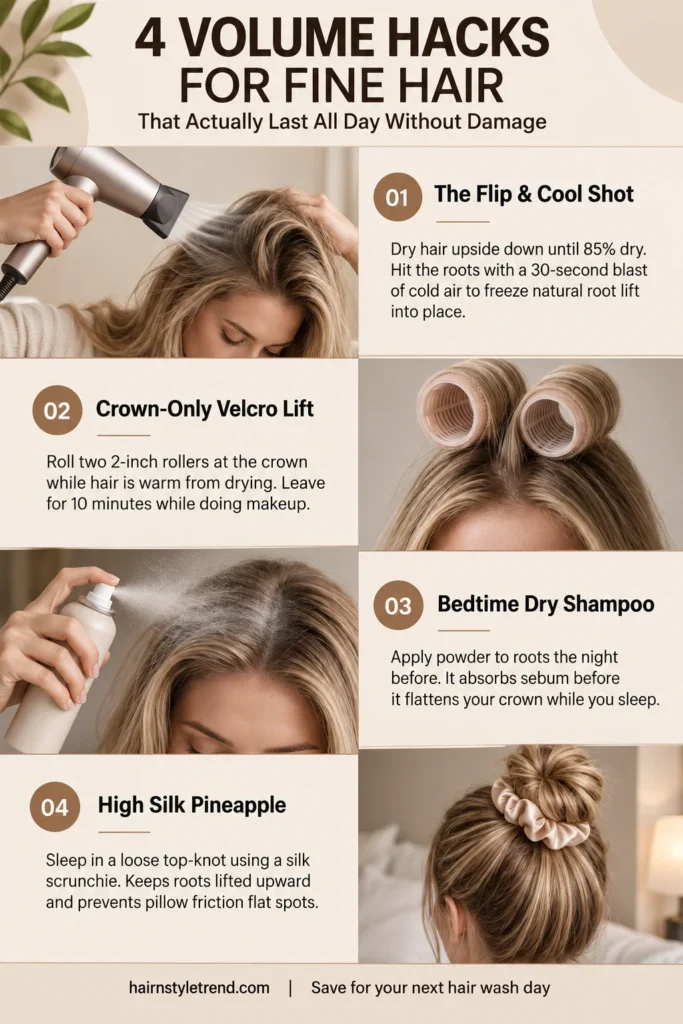
Flip Upside Down, Then Finish with the Cold Shot
Drying your hair in the direction it normally falls trains it to lie flat before you’ve even started styling. Flipping your head over does the opposite, because the roots dry standing away from the scalp instead of glued to it.
- Work a light mousse or root spray into the first inch of your roots only, never the lengths.
- Flip forward and dry the roots on medium heat until they’re about 80 percent dry, ruffling with your fingers.
- Now hit the cold shot button and run cool air over your roots for a full 30 seconds.
Use Dry Shampoo at Night, Not in the Morning
Most of us reach for dry shampoo after the oil has already shown up, which means we’re mopping up a spill instead of preventing it. Applied the night before, it absorbs sebum as your scalp makes it, and it has hours to settle in so you skip the chalky white cast.
- Spray lightly along your part and around the crown before bed, holding the can about 10 inches away.
- On non-wash days, this alone can buy you a full extra day of root lift for flat hair.
Move Your Part and Break the Cowlick
Your hair has been falling the same way for years, and the roots have basically memorized that direction. Shifting the part forces them to stand up as they fight their way back, and that tiny bit of resistance reads as volume.
- The deep side flip. Part your hair much further over than usual and flip the heavier section across your head. The sudden change in direction props the whole crown area up.
- The zig-zag part. Run the end of a rat-tail comb in a soft zig-zag instead of a straight line. It scatters the hair so no clean scalp line shows through, which makes a thin part look denser instead of exposed.
Crown-Only Velcro Rollers for Heatless Lift
This is the one trick I’d hand to every fine-haired client if I could. Three or four medium velcro rollers, placed only at the crown, give you a lifted shape with no heat and no tension on the hair shaft.
- Take a section about the width of the roller, lift it straight up, and roll it down toward the scalp.
- Leave them in for 10 to 15 minutes while you do your makeup, then unroll downward, never yanking.
Leave the lengths alone. Rollers all over fine hair look set and rounded, but rollers at the crown alone just look like you woke up with better hair.
Clear Shampoo, and Conditioner from the Ears Down
Flip your shampoo bottle over and look at the texture. Clear, gel-like formulas tend to be lighter and rinse away cleanly, while pearlized or milky ones usually carry conditioning agents that coat the strand and sit on fine hair like a film.
Conditioner is where fine hair gets quietly sabotaged. The rule is simple and non-negotiable: ears down only.
- Keep every drop below your earlobes, use a coin-sized amount, and rinse longer than feels necessary.
- Save rich masks for your ends, and rinse them out fully before you towel off.
Dry Texturizing Spray Beats Sticky Hairspray
Traditional firm-hold hairsprays work by gluing strands into position. On fine hair, that glue adds weight and clumps thin strands into even thinner-looking pieces, so the volume you sprayed to keep disappears.
A dry texturizing spray does something different. It roughens the surface of each strand so they catch on each other instead of sliding into a flat sheet, and that friction is what holds hair apart and up.
- Lift sections in layers and spray underneath at the roots, not over the top of your finished style.
- If your hair feels stiff or crunchy, you’ve used too much. Dry texturizing spray on fine hair should feel gritty, never tacky.
Protect the Lift While You Sleep
Eight hours of your head pressing into a pillow will undo a good blow-dry, and fine hair breaks easily when it’s pulled tight. The fix is a loose, high pineapple that keeps the roots off the pillow without any strain.
- Flip your head forward, gather everything loosely at the very top, and wrap a silk scrunchie once or twice.
- Sleep on silk or satin so your hair glides instead of rubbing itself into frizz.
A Safer Way to Tease Your Roots
Aggressive backcombing with a stiff plastic comb does give you instant height. It also roughs up the cuticle and leaves fine hair with tangles that break on the way out, which is how so many people end up with wispy, damaged crown hair.
- Root powder. Tap a pinch directly onto the scalp along your part, then press the roots upward with your fingertips. The powder grips and holds them there.
- A soft teasing brush. Use gentle, shallow strokes at the base of the section only, going about an inch deep rather than dragging down the shaft.
Let Color Fake the Density
Flat, single-block color acts like a mirror, so light bounces off in one sheet and the hair reads as a thin, solid layer. Dimension does the opposite, because shadows and highlights trick the eye into seeing depth where there’s air.
- A shadow root. Keeping the root slightly darker than the lengths makes the scalp less visible through the hair, especially along the part.
- Soft balayage. Painted, irregular lightness through the mid-lengths creates the illusion of separate layers stacked on top of each other.
Your cut works the same way. For more on shapes that build weight instead of removing it, browse our haircuts for fine hair guides.
Quick Reference: What Flattens vs. What Lifts
| Habits That Flatten Fine Hair | Hacks That Lift Fine Hair |
|---|---|
| Conditioner applied from the scalp down | Conditioner from the ears down only |
| Drying hair in its natural falling direction | Upside-down root drying with a cold shot finish |
| Dry shampoo used after roots turn oily | Dry shampoo applied the night before |
| Sticky firm-hold hairspray over the whole head | Dry texturizing spray misted under the roots |
| Harsh backcombing with a plastic comb | Root powder plus a soft teasing brush |
| The same part every single day | A zig-zag part or deep side flip |
| Tight elastics and cotton pillowcases | A loose silk-scrunchie pineapple on silk or satin |
Fine Hair Volume FAQ
Why does my fine hair go flat so quickly?
Three things are working against you at once. Each strand is thinner, so it holds less shape on its own, gravity pulls it down faster, and your scalp’s oils spread down a smooth thin strand far more quickly than a coarse one. Add any heavy product to that and the root has no chance.
How often should I wash fine, oily roots?
Most fine-haired people do best washing every one to two days with a gentle clear shampoo. Stretching washes to “train” your scalp usually backfires, because oil sitting at the root is the fastest route to flat hair.
Do layers help or hurt fine hair?
It depends entirely on where they’re cut. Soft, shallow layers around the crown and face build movement and make hair look fuller, while long, heavily thinned layers strip weight from the ends and leave them wispy and see-through. Ask for a blunt perimeter with minimal internal layering.
Volumizing mousse or dry texturizing spray?
They do different jobs, so it’s not really a contest. Mousse goes on damp hair before drying and builds the foundation, while dry texturizing spray goes on dry hair and adds grit that keeps the lift going through the afternoon. If you only want one, pick mousse for wash days and texturizing spray for day two.
If there’s one thing to take from all of this, it’s that fine hair volume comes from taking things away, not piling more on. Lighter products, less conditioner near the roots, less tension, and a bit of smart friction will always beat another thick cream promising thickness.
Pick two hacks to try this week instead of all nine, and see which ones your hair actually responds to. Fine hair can hold beautiful shape when you stop fighting what it is and start working with it. For more ideas, our volume and thickness section is full of them, and the hair care for fine hair guides cover the wash-day side in more detail.
Save these fine hair volume hacks, so they’re ready on your next flat-root morning.