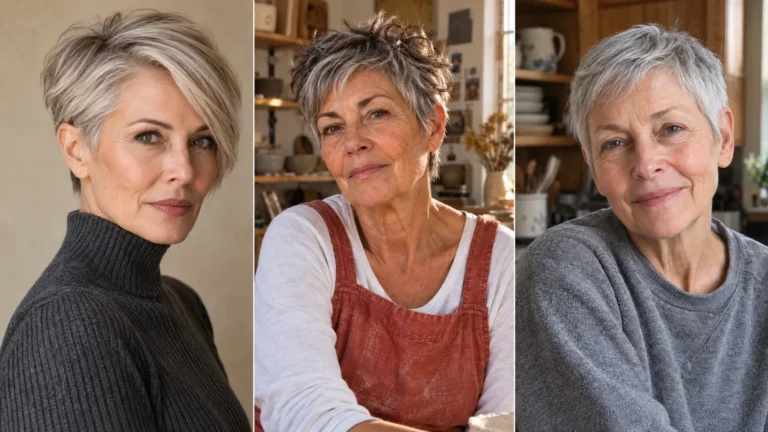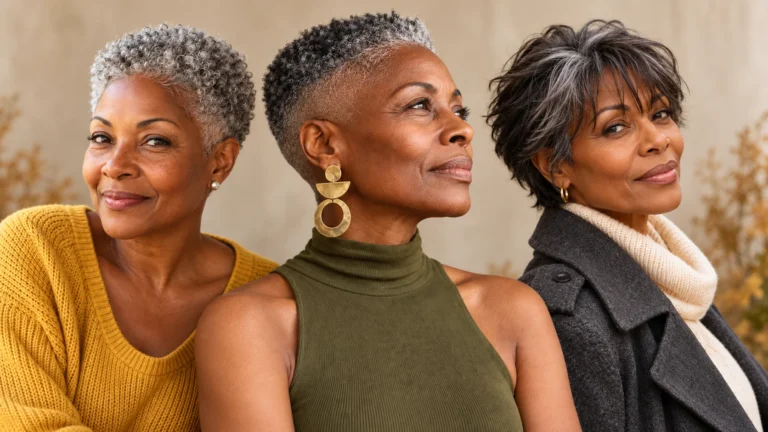
Over 50 Glasses Hairstyles: 12 Chic Cuts That Work With Your Frames
You handed your glasses to the receptionist, sat through the cut, admired it in the mirror, and then put your glasses back on in the car. Suddenly there were two little wings of hair sticking straight out over the arms, and the fringe you loved was resting on top of your rims.
Almost nobody thinks to keep their glasses on in the chair, and almost every stylist forgets to ask. But if you wear them every single day, they’re part of your face, and a cut that ignores them is a cut that fights you every morning.
There are real mechanics behind this. Frame arms need somewhere flat to sit, which means the hair above your ears has to be tapered rather than left heavy. Fringes need clearance above the rims, and bold frames need crown height to balance them, otherwise all the visual weight collects at the bottom of your face.
Get those three things right and something shifts. Your glasses stop being a thing you work around and start looking like a deliberate part of how you put yourself together.
The Three Golden Rules of Haircuts with Glasses
Rule One: Blend the Temples
This is the flaring problem, and it’s the most common one. When the hair above your ears and in the sideburn area is left heavy or cut with a blunt line, the frame arm can’t lie flat against your head. It pushes the hair outward, and you get that little wing on each side.
The fix is tapering. That section needs to be feathered and blended so it lies close to your head, letting the arms rest on top of the hair rather than fight through it.
It’s a small technical detail that most stylists will happily do, but almost none will do unprompted. Ask for it by name.
Rule Two: Give the Fringe Clearance
A heavy, straight fringe cut to brow level ends up sitting directly on your rims. It crowds your eyes, catches on the frames every time you push them up, and you spend the day separating it with your fingers.
Wispy and curtain fringes solve this. A wispy fringe is thinned enough that light passes through it, so even when it grazes the rims it doesn’t look like a solid shelf. A curtain fringe parts in the middle and sweeps outward, which clears the frame area entirely.
Both leave your eyes visible behind the lenses, which matters more with glasses than without. Your frames already draw a line across your face, and you don’t want a second one from your hair.
Rule Three: Balance the Volume
Glasses add weight to the middle of your face. Bold, dark, or heavy frames add a lot of it, and if your crown is flat, all that visual weight sits low and makes the whole face look bottom-heavy.
Height at the crown counterbalances it. The eye travels up instead of settling at your frames, and the proportions read as intentional rather than accidental.
This applies doubly if your hair has thinned at the crown, which is where most women over 50 lose density first. Building lift there is doing two jobs at once, and our volume and thickness guides cover the styling side in detail.
The 12 Most Flattering Hairstyles with Glasses Over 50
Each cut below solves a specific frame problem. Start with the one closest to your current length, and pay attention to the frame pairings, since the shape of your glasses changes what works.
1. The Tapered Pixie with Blended Sideburns

Short all over with the sideburn and temple area tapered close and blended into the sides, so nothing sits under the frame arms.
It’s the cleanest solution to the flaring problem on this list, because the cut is designed around the arms rather than adjusted for them afterwards. The short length also keeps your face fully open behind the lenses.
- Best frame pairing: Bold, chunky, or dark frames, which need short hair to balance rather than compete with them.
- Why it works: Tapered temples let the arms sit flush, and crown height counterbalances heavy frames.
- Styling in under 10 minutes: Root spray at the crown, rough-dry upward with your fingers, then smooth the sides down with damp palms.
- Skip it if: You can’t get to the salon every five or six weeks, since the tapered temple area grows out fast.
2. The Chin-Length French Bob with Wispy Fringe

A blunt bob landing right at the chin, paired with a fine, airy fringe you can see skin through.
The length is the clever part. It finishes just below your frames, so the two shapes stack rather than collide, and the blunt line gives fine hair a solid edge that reads as thickness.
- Best frame pairing: Round and oval frames, which soften against the strong horizontal line of a blunt bob.
- Why it works: The chin length clears the frames entirely, and the wispy fringe sits above the rims without crowding your eyes.
- Styling in under 10 minutes: Blow-dry with a medium round brush turning the ends under, dry the fringe side to side, finish with cool air.
- Skip it if: You have a very short neck, in which case dropping the length an inch lower works better.
3. The Soft Curved Bixie
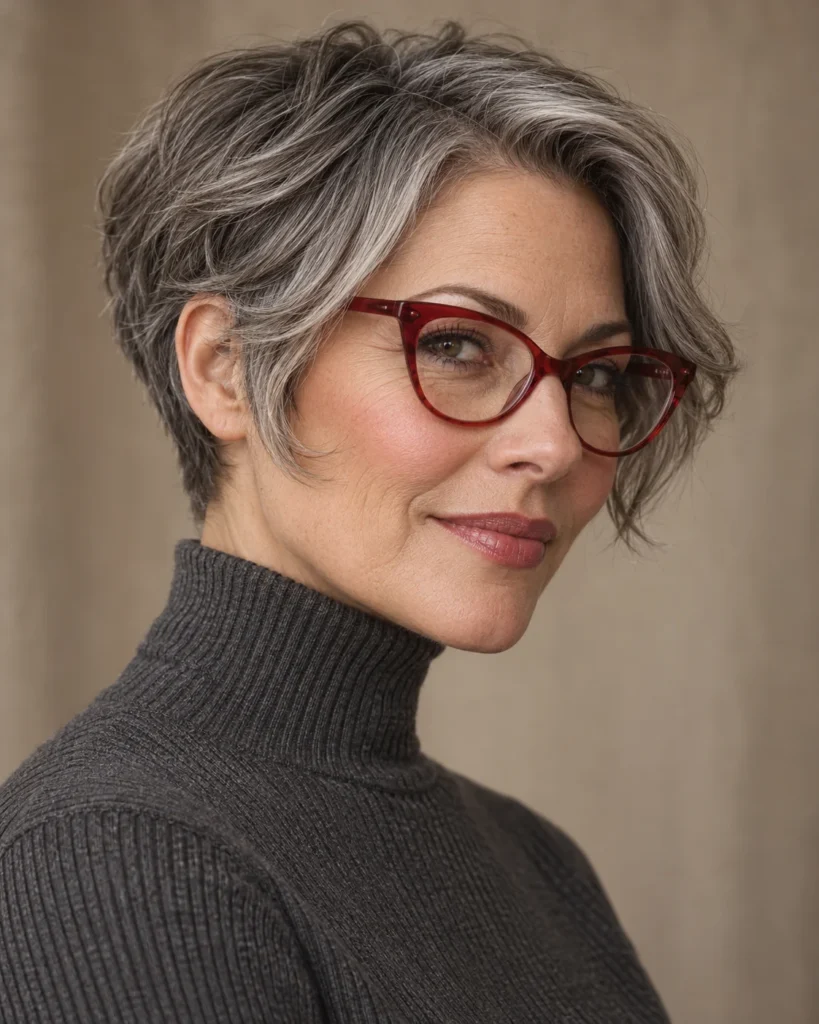
Part pixie, part bob. Short layers through the crown with the front length kept near the jaw, so it reads as a bob from the front and a pixie from behind.
With glasses, this is the most forgiving shape here. The sides tuck in close so frames sit cleanly, while the front length keeps your face softly framed, which is what most women miss when they go fully short.
- Best frame pairing: Cat-eye and upswept frames, which pick up the diagonal lift of the crown layers.
- Why it works: Close sides clear the arms, and crown height stops bold frames from dominating the face.
- Styling in under 10 minutes: Rough-dry upside down, push the crown up and the front forward with your fingers. Four minutes, honestly.
- Skip it if: You want one uniform length, since this cut depends on the contrast between crown and front.
4. The Side-Swept Asymmetrical Bob

A deep side part with one side cut noticeably longer, creating a strong diagonal across the face.
That diagonal is doing something specific with glasses on. Frames draw a horizontal line across your face, and a diagonal sweep cuts across it, which keeps your features from looking like a set of stacked horizontal bands.
- Best frame pairing: Rectangular and angular frames, which need a diagonal to soften their straight lines.
- Why it works: The deep part builds crown lift at the root, and the sweep covers thinning temples where arms sit.
- Styling in under 10 minutes: Dry the roots at the part in the opposite direction first, then flip the hair back over.
- Skip it if: You change your part regularly, because this cut commits to one side.
5. The Collarbone Lob with Soft Curtain Bangs

Length stopping just above the collarbone with a fringe that parts in the middle and sweeps outward to about cheekbone level.
The curtain is the single best fringe for glasses. It splits and moves away from the frame area entirely, so nothing rests on your rims, while still softening your forehead.
- Best frame pairing: Almost anything, which is why this is the safest cut here. It’s especially good with larger frames.
- Why it works: The curtain clears the rims completely, and the length keeps enough hair for a ponytail on busy days.
- Styling in under 10 minutes: Dry the fringe first, brushing it back and away from your face, then rough-dry the rest.
- Skip it if: Your hair is very fine overall, since any fringe borrows density from the rest of the cut.
6. The Textured Shaggy Crop with Eyebrow-Grazing Wisps

A short, layered crop with fine wisps falling to eyebrow level, cut soft and irregular rather than blunt.
The wisps land just above your frames without ever resting on them, and because they’re fine and separated, they read as movement rather than a fringe. It’s the most relaxed shape on this list.
- Best frame pairing: Round and oversized frames, which suit the undone texture of a shag.
- Why it works: Eyebrow-level wisps clear the rims, and the layered crown gives lift without any styling effort.
- Styling in under 10 minutes: Scrunch light mousse into damp hair, diffuse on low, then separate the pieces with your fingers.
- Skip it if: You want a polished, precise look, since this shape is deliberately undone.
7. The Feathered Layered Midi

Just past the shoulders with soft feathered pieces starting at the cheekbone, cut with scissors rather than a razor.
For women who don’t want to go short, this keeps length while stopping the hair from hanging as a flat curtain either side of your frames. Those front pieces give the glasses room to breathe.
- Best frame pairing: Rectangular and cat-eye frames, which benefit from soft movement around them.
- Why it works: Face-framing feathering creates space around the frames rather than crowding them.
- Styling in under 10 minutes: Curl just the front pieces away from your face, leave the back straight or loosely bent.
- Skip it if: Your ends are already thin, since length below the shoulders needs density to carry it.
8. The Modern Spiky Pixie with Soft Temples

Texturized pieces on top that you can push in any direction, with the temple area deliberately kept soft and tapered rather than sharp.
The contrast is the point. Texture and height on top, smooth and close at the temples, which means bold frames have somewhere clean to sit while the crown carries all the visual interest.
- Best frame pairing: Bold, colorful, or statement frames. This is the cut that lets you wear the frames you actually want.
- Why it works: Maximum crown height balances heavy frames, and soft temples prevent any flaring.
- Styling in under 10 minutes: Matte paste rubbed between dry palms and pushed through the top. Skip shiny gels, which flatten fine hair.
- Skip it if: You want something soft and romantic, or you can’t commit to a trim every five weeks.
9. The Ear-Tuck Sleek Bob

A clean bob cut just below the jaw, designed to be worn tucked behind one ear.
Tucking is something glasses wearers do instinctively anyway, so this cut makes it intentional. The tucked side clears the arm completely, and the loose side keeps the shape soft.
- Best frame pairing: Delicate wire and rimless frames, which suit the minimal, uncluttered look.
- Why it works: One side is permanently clear of the arm, and the slight asymmetry reads as deliberate rather than accidental.
- Styling in under 10 minutes: Rough-dry, tuck one side, add a mist of texture spray at the roots. Under five minutes.
- Skip it if: You’d rather not have one ear on show, since it always is with this cut.
10. The Soft Curved Wedge Bob

Graduated through the back so weight builds into a rounded curve at the back of the head, tapering down to the nape.
With glasses, the profile view matters more than you’d think. Frames give your face a strong side silhouette, and a flat back of the head throws that off. The wedge rebuilds the curve and balances the whole head shape.
- Best frame pairing: Larger and deeper frames, which need a fuller head shape to sit against.
- Why it works: The back curve balances the visual weight of frames from the side, and the shorter nape keeps the sides tidy.
- Styling in under 10 minutes: Dry the back sections lifted straight out from the head, then let them fall and set with cool air.
- Skip it if: You wear your hair tied back most days, since the shorter back won’t reach.
11. The Wispy-Fringe Shoulder Cut

Shoulder-grazing length with a fine, thinned fringe cut just above the brows so it never touches the rims.
This is for women who want a fringe and refuse to give up their length. The key is how thin the fringe is cut, because a full one at this length turns into a shelf resting on your frames.
- Best frame pairing: Round and oval frames, which suit the softness of a wispy fringe.
- Why it works: The fringe stops above the rims by design, and the length keeps your styling options open.
- Styling in under 10 minutes: Dry the fringe first with a flat brush, moving it side to side so it doesn’t set in one direction.
- Skip it if: You push your glasses up onto your head, since that habit destroys a wispy fringe instantly.
12. The Brushed-Back Voluminous Crop

Short with all the length swept up and back from the face, and enough weight on top to hold the direction.
Nothing falls forward at all, which means nothing competes with your frames. Your glasses become the focal point of your face, and the height at the front frames them from above.
- Best frame pairing: Statement frames of any kind. This cut gives them the stage entirely.
- Why it works: Zero hair near the temples or brows, and maximum crown height to balance bold eyewear.
- Styling in under 10 minutes: Blow-dry backward with a vent brush, then set with light spray. A headband while you finish dressing helps it hold.
- Skip it if: You use a fringe to soften your forehead, because this cut removes that option.
What to Tell Your Stylist in the Chair
Photos show a result. These four sentences describe the technique, which is what your stylist can actually work from.
- Say this: “I’d like to keep my glasses on for the consultation and the final dry check, please.”
- Say this: “Can you thin and blend the temple hair so my frames sit flush against my head?”
- Say this: “Please cut my fringe to clear the top of my rims, and keep it wispy rather than solid.”
- Say this: “I need height through the crown to balance these frames.”
That first sentence changes everything. Hair falls differently once the arms are in place, and a stylist who can see that while cutting will make small adjustments you’d never think to ask for. For more on shapes that protect density, our haircuts for fine hair guides go deeper.
Styles That Fight Your Glasses vs. Styles That Complement Them
| Styles That Fight Your Glasses | Styles That Complement Them |
|---|---|
| Heavy, blunt hair left over the ears | Tapered, feathered temples the arms sit flush against |
| A heavy blunt fringe resting on your rims | A wispy or curtain fringe that clears the frames |
| A flat crown paired with dark, bold frames | Crown height that balances the weight of the frames |
| Length that stops level with your cheeks | Length that finishes below the frames, at the chin or collarbone |
| A cut chosen with your glasses off | A cut checked and finished with your glasses on |
| Razor-thinned ends that fray around the face | Scissor-cut feathering that holds its shape |
| One flat horizontal line from hair and frames together | A diagonal sweep that breaks up the horizontals |
Frequently Asked Questions
What’s the best cut for a round face with glasses?
Height at the crown and length that finishes below the jaw. Both add vertical line to the face, which is what balances roundness, while volume level with your cheeks does the opposite and adds width.
The bixie, the side-swept asymmetrical bob, and the collarbone lob all work well. Frame shape matters too, since angular or rectangular frames add structure where a round face benefits from it most.
How do I stop my fringe catching on my glasses?
Usually the fringe is either too heavy or cut to exactly rim level. Ask for it thinned so it’s airy, and cut either clearly above the rims at brow level or long enough to sweep to the sides.
The in-between length is the problem, because it sits right on the frames with nowhere to go. A curtain fringe avoids the issue completely by parting away from the center.
Should I take my glasses off while my stylist cuts?
For the cutting itself, yes, since the arms genuinely get in the way. But put them on for the consultation at the start and for the final dry check at the end.
Those two moments are where the cut gets adjusted to your actual face. If your stylist doesn’t suggest it, say it yourself.
Can I wear long hair with glasses over 50 without looking dated?
Absolutely, and the rule is the same as at any age. What dates long hair isn’t the length, it’s flatness at the roots and ends that have gone thin and stringy.
Keep the perimeter blunt, add face-framing pieces so the hair doesn’t hang as a curtain either side of your frames, and build lift at the crown. Length past the shoulders looks modern when it has shape and movement in it.
Your glasses are the accessory you wear every single day, more than any necklace or scarf you own. They deserve a haircut built around them rather than one that merely tolerates them.
Pick the cut that solves your biggest frustration, keep your frames on in the chair, and ask for the temple blend by name. For more ideas at every length, browse our hairstyles over 50 section.
Pin all 12 styles to your hair board, then take the one you picked and the four talking points to your next appointment.