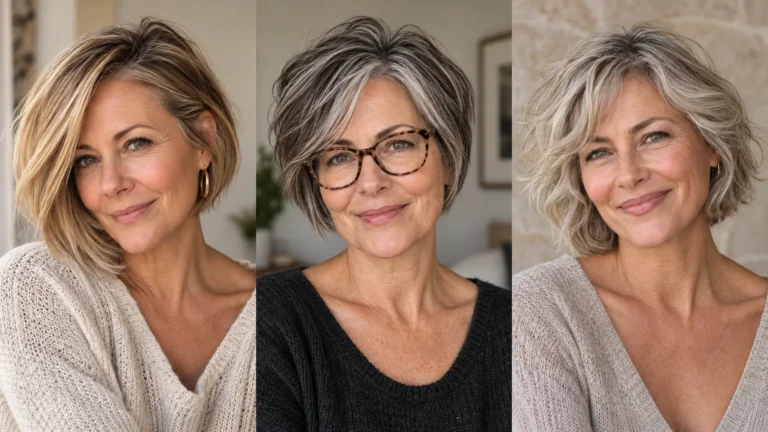
15 Layered Bob Hairstyles for Women Over 60 with Glasses
Finding a layered bob over 60 with glasses that actually works starts with one small salon request almost nobody makes. Your stylist asks you to take your glasses off so she can see what she is doing, and that is reasonable. She then cuts for forty minutes without ever seeing your frames on your face.
You put them back on at the end and the sides kick outward over the arms like two little wings. Nobody did anything wrong. The cut simply had no idea the frames existed.
Glasses put two strong horizontal lines across the middle of your face, usually in a dark colour. A bob draws its own horizontal line wherever it ends. Put those two lines in the wrong relationship and the face gets cut into stacked bands. Put them in the right one and the frames start doing work for you.
Add the thing nobody mentions. After sixty, temple density goes first, and the temple is exactly where a frame arm sits. Layers cut without accounting for that leave two thin patches on either side of your face, framed by the very thing drawing attention to them. Every cut below treats the frames as part of the structure.
The Glasses and Bob Compatibility Rules
Never let the whole cut happen with your glasses off. Take them off for the sectioning if she needs it, but put them back on before the final dry check. The drape over the frame arms is the one thing that cannot be judged without them.
Keep a quarter inch of brow rim clearance. A fringe either sits above the top rim of your frames or splits past the outer corners. Anything landing exactly on the rim looks like a mistake and catches on the lenses all day.
Carve an arm pocket behind the ear. A small amount of internal weight removed just behind the ear gives the frame arm somewhere to sit. Without it the arm shoves a wedge of hair outward and that is your wing flare.
Scissors only, no razor. Silver hair is coarser and more porous, and a razor leaves the ends frayed. Frayed ends snag on frame hinges and frizz within weeks.
15 Layered Bob Styles That Work With Glasses
Each one is matched to a frame type, because the frames you wear every day should decide the cut more than any trend does.
Look 01 • Everyday frames
1. The Tapered-Temple Jaw Bob

A clean jaw-length bob with the hair above and behind the ear cut noticeably closer to the head. That taper is the whole point, because it is the single most reliable fix for side flare.
If you own one pair of ordinary everyday glasses and want one cut that never fights them, this is it.
Best frame match: Everyday plastic or metal frames, medium width
The glasses clearance trick: Hair above the ear cut closer so the arm never lifts it
Morning routine: Smooth the sides with damp palms, rough-dry the top. Four minutes.
Stylist chair script: “Taper the sides closer above my ear, keep the perimeter blunt.”
Look 02 • Round frames
2. The Arched Curtain Fringe Bob

A chin-length bob with a fringe parted in the middle and arched so the shortest point clears the top rim of your frames by a quarter inch, then sweeps down past the outer corners.
Round frames need something angular nearby or the whole face reads as circles. The arch supplies that without a hard line.
Best frame match: Round and oval frames
The glasses clearance trick: The arch lifts over the rim instead of resting on it
Morning routine: Round brush the fringe backward and away. Three minutes.
Stylist chair script: “Cut the fringe with my glasses on so you can see the rim line.”
Look 03 • Statement frames
3. The Graduated Stacked Bob

Shorter and stacked at the back, longer toward the front. Bold frames are visually heavy, and without height somewhere above them the whole face sinks.
The stacking puts that height exactly where fine hair collapses first, which is the crown.
Best frame match: Thick acetate and bold statement frames
The glasses clearance trick: Volume sits high at the crown, well clear of the arms
Morning routine: Lift the back sections out as you dry, finish with cold air. Six minutes.
Stylist chair script: “Graduate the back for height, angle it longer at the front.”
Look 04 • Small delicate frames
4. The French Bob With a Micro-Fringe

Cheek-level bob with a short fringe sitting well above the brows. Because the fringe stops so high, it never comes near the frames at all, which removes the clearance problem instead of managing it.
It is the boldest cut here and it suits fine features and small frames far better than large ones.
Best frame match: Small round, oval and thin metal frames
The glasses clearance trick: The fringe ends far above the rim, so there is nothing to clash
Morning routine: Flat brush, press the fringe down with fingertips. Four minutes.
Stylist chair script: “Cheek-level bob, fringe a full inch above my brows.”
Look 05 • Cat-eye frames
5. The Deep Side-Part Asymmetric Bob

One side cut longer, worn with a deep part sweeping across the top. The diagonal of the sweep runs the same direction as an upswept frame corner, so the two lines agree instead of arguing.
The deep part also lifts the roots as it crosses, which is useful if your crown has gone flat.
Best frame match: Cat-eye and any upswept corner frame
The glasses clearance trick: The sweep crosses above the frames rather than beside them
Morning routine: Set the part soaking wet, dry it in place. Five minutes.
Stylist chair script: “Set my part deep to one side first, then cut the asymmetry around it.”
Look 06 • Progressive lenses
6. The Tuckable Collarbone Lob

Longer, finishing at the collarbone, cut so the front sections tuck cleanly behind the ear and stay there. If you wear bifocals or progressives you move your head up and down all day, and loose front pieces swing into the lenses constantly.
Length past the jaw also means the hair clears the frame arms entirely rather than meeting them.
Best frame match: Progressives, bifocals, reading glasses worn on and off
The glasses clearance trick: Front length cut to tuck and hold behind the ear
Morning routine: Mousse at the roots, bend the mid-lengths, tuck the front. Seven minutes.
Stylist chair script: “Cut my front pieces long enough to tuck behind my ear and stay put.”
Look 07 • Rimless frames
7. The Scissor-Feathered Silver Bob

Ends feathered and point-cut with scissors into a soft airy finish. Rimless frames nearly disappear on the face, so the hair carries all the visual interest, and a soft feathered edge gives it without adding weight.
Silver hair is more porous than pigmented hair, which changes how it holds product and heat. Our porosity finder sorts out which side of that you are on.
Best frame match: Rimless and semi-rimless frames
The glasses clearance trick: Feathered ends sit flat instead of bunching at the arm
Morning routine: Light leave-in on the ends, air-dry, separate with fingertips. Four minutes.
Stylist chair script: “Scissors and point-cutting only, no razor near my ends.”
Look 08 • Heavy acetate frames
8. The Close-Temple Bixie

Part bob, part pixie, with short layers through the crown and the temples kept very close to the head. Thick frames need space around them, and this is the only cut here that gives them a completely clear run.
It also fakes the most density, because short crown layers prop up everything above them.
Best frame match: Thick acetate, chunky square and oversized frames
The glasses clearance trick: Temples cut close so there is no bulk for the arm to displace
Morning routine: Rough-dry upside down, push the crown up with your fingers. Three minutes.
Stylist chair script: “Keep my temples close, build the height at the crown instead.”
Look 09 • Rectangular frames
9. The Side-Swept Bang Bob

A bob with the fringe swept across at an angle so it crosses the forehead diagonally and ends past the outer corner of the frame.
Rectangular frames already draw a firm horizontal line. The diagonal cuts across it and stops the face reading as a set of stacked bars.
Best frame match: Rectangular and wayfarer frames, especially on round faces
The glasses clearance trick: The sweep finishes past the frame corner, never on top of it
Morning routine: Dry the fringe sideways with a flat brush. Four minutes.
Stylist chair script: “Sweep the fringe across so it finishes outside my frame corner.”
Look 10 • Thinning temples
10. The Internally Layered Bob

From the outside this reads as one solid shape. Every layer sits underneath where nobody sees it, which matters enormously if your temples have thinned, because no weight is removed from anywhere visible.
The thinking behind it runs through all our cuts for fine hair, and it matters more here than anywhere.
Best frame match: Any frame, particularly dark ones that highlight sparse temples
The glasses clearance trick: Weight removed internally so the sides lie flat with nothing taken off the edge
Morning routine: Mousse at the roots, rough-dry, smooth the sides down. Five minutes.
Stylist chair script: “Take the weight out internally only, nothing off my outline.”
Look 11 • Half-rim frames
11. The Rounded One-Length Bob

A single clean length with the interior rounded so the ends curve gently inward. Half-rim frames have a strong top line and nothing underneath, and a curved hemline balances that rather than repeating it.
Hair curving inward also takes up more visual space than hair hanging straight, which helps when density is low.
Best frame match: Half-rim and browline frames
The glasses clearance trick: The curve pulls the ends inward and away from the arms
Morning routine: Large round brush, roll the ends under on the last pass. Six minutes.
Stylist chair script: “One length, rounded interior, ends curving under.”
Look 12 • Warm tortoiseshell
12. The Air-Dried Wavy Bob

Cut to work with whatever natural bend your hair has rather than drying it flat every morning. Tortoiseshell and warm-toned frames look softer against texture than against a polished blowout.
If the waves collapse by mid-afternoon, the cooling step is usually the missing piece. Our volume and thickness guides cover it properly.
Best frame match: Tortoiseshell, amber and warm-toned frames
The glasses clearance trick: Waves start below ear level so the top stays smooth against the arms
Morning routine: Scrunch light mousse into damp hair and leave it. Three minutes.
Stylist chair script: “Cut it dry so you can see where my wave actually sits.”
Look 13 • Petite frames
13. The Tapered-Nape Chin Bob
Chin length with the nape tapered close underneath. Fine hair tends to sit flat and cling at the back of the neck, and a small frame on a small face gets overwhelmed when the hair pools down there.
The taper stays below the occipital bone, so your visible perimeter is untouched.
Best frame match: Petite and narrow frames on smaller faces
The glasses clearance trick: Weight removed at the nape rather than the sides, so the arms stay clear
Morning routine: Dry the back first while it is wettest, flicking outward. Four minutes.
Stylist chair script: “Taper the nape only, leave my sides completely blunt.”
Look 14 • Wide frames
14. The Centre-Split Curtain Bob
The front splits down the middle and falls either side of the face, with the bob kept full through the back. Wide frames stretch the face horizontally, and two vertical curtains of hair pull it back the other way.
It works especially well on longer faces, where the width is welcome and the vertical lines stop it looking narrow.
Best frame match: Wide, oversized and square frames
The glasses clearance trick: Front pieces fall in front of the arms, not over them
Morning routine: Set the centre split wet, dry each side downward. Five minutes.
Stylist chair script: “Split the front down the middle, keep the back full.”
Look 15 • Low-set frames
15. The Wispy-Fringe Bob
A soft bob with a fine see-through fringe cut from a shallow section. If your frames sit low on your nose or your forehead is high, this fills the gap between hairline and rim without adding a heavy block of hair.
See-through is the operative word. A thick fringe on fine hair borrows density you cannot spare.
Best frame match: Low-sitting frames and reading glasses worn down the nose
The glasses clearance trick: Cut from a shallow section so it stays light enough to sit above the rim
Morning routine: Dry the fringe side to side, no product at all. Two minutes.
Stylist chair script: “Wispy fringe from a shallow section only, and check it with my glasses on.”
What to Tell Your Stylist in the Chair
Say this during the consultation, while your glasses are still on. Once the cutting starts it is too late.
“I wear these frames every day, so please check the side layers with my glasses on before you finish.”
“Can you take a little weight out behind my ear so the arm does not push my hair outward?”
“My fringe needs to clear the top of my frames, not sit on them.”
“Scissors only please, no razor and no thinning shears on my ends.”
One more thing worth knowing if your temples feel sparser than they used to. Frames resting in the same spot every day, tight styles and heat all add up over the years. The American Academy of Dermatology covers the basics in their tips for healthy hair, and anything changing quickly is worth asking a doctor about rather than styling around.
Frequently Asked Questions
How do I stop my bob flaring outward over my glasses arms?
Ask for a small amount of internal weight removed just behind and above the ear, and have the sides tapered closer to the head there. The flare happens because the frame arm has nowhere to sit, so it lifts a wedge of hair outward. Once there is a pocket for it, the arm slides on and the hair stays flat.
What is the most youthful bob length with thick statement frames?
Jaw length or just above, with height built into the crown. Bold frames are visually heavy and a longer bob lets the whole face drift downward. Lifting the eye upward with crown volume and stopping the hair at the jaw balances the weight of the frames instead of adding to it.
Should bangs touch the top of my glasses?
No. A fringe should either clear the top rim by about a quarter inch or be long enough to sweep past the outer corners. Hair landing exactly on the rim looks unintentional, catches on the lenses and leaves smudges you will be cleaning off all day.
How can I hide thinning temples when my glasses draw attention there?
A curtain fringe or a soft side sweep covers the temple corners without borrowing density from anywhere that shows. Keep all layering internal so nothing is removed from the visible outline. Lighter frames in a thinner material also draw far less attention to that area than heavy dark acetate does.
A layered bob over 60 with glasses is not a compromise between two things that do not fit. The frames are already part of how your face is read, every day, by everyone who looks at you.
Cut the hair with that in mind and the two stop competing. Keep your glasses on for the final check, insist on scissors, and ask for the pocket behind your ear. Three small requests, and you walk out with a cut that fits the face you actually wear.