Protein vs Moisture for Fine Hair: Which One Do You Need
Your hair feels like straw, so you reach for the thickest mask on the shelf. Two days later it is soft, limp and sitting flat against your scalp. You swing back to a strengthening treatment and now it feels stiff and snaps off in the comb.
Here is the short answer. If you’re deciding between protein and moisture for fine hair, start with how your hair feels after washing. If it feels dry but goes flat after a rich mask, try a lightweight rinse-out conditioner on the ends. If you want to try a protein treatment, change one product at a time and follow the label directions. A wet strand can show you how your hair stretches, but it can’t tell you whether you need protein or moisture.
Below, you’ll learn what a wet strand can show you, why some masks leave fine hair feeling flat, and how to choose a lightweight conditioner or try a protein treatment one product at a time.
Pull One Wet Strand and See What It Tells You
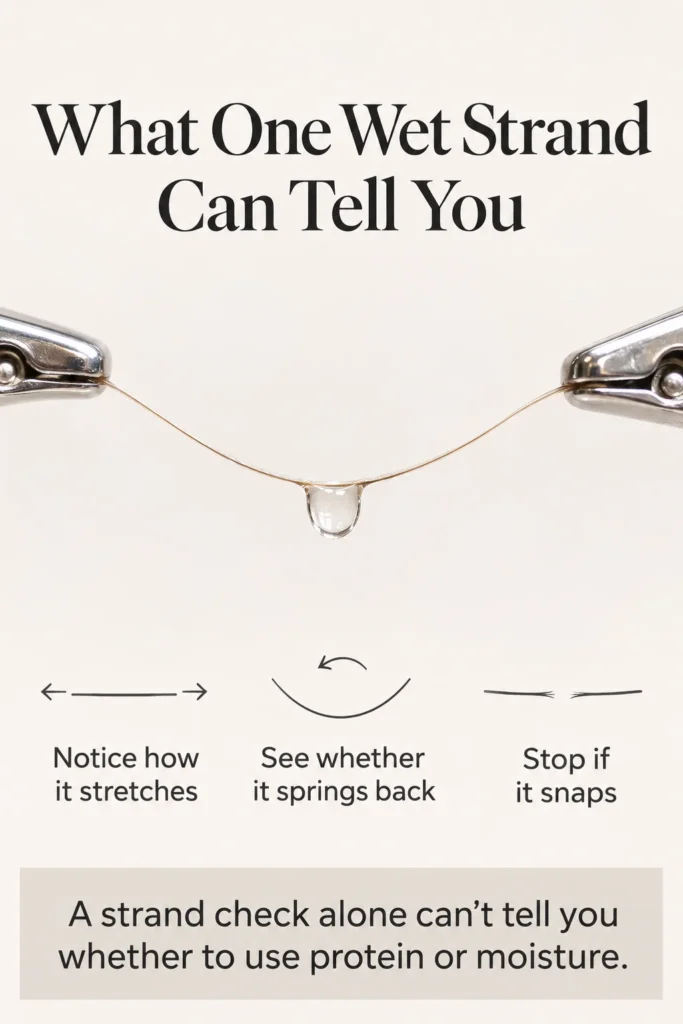
This is the hair stretch test, and it takes about fifteen seconds. It settles the question of protein vs moisture for fine hair faster than any amount of reading labels. Treat it as a rough indicator rather than a diagnosis, but it points you in the right direction far better than guessing from how your hair looks.
Take one shed strand from your brush, or a single strand still attached, and wet it. Hold it between the thumb and finger of both hands, then pull gently outward until you feel resistance.
Reading the result
Stretches a long way, feels gummy, does not spring back. Leaning toward too much moisture and not enough protein. Your hair needs structure.
Barely stretches, snaps fast, feels rough. Leaning toward too much protein or simply too dry. Your hair needs moisture.
Stretches a little and springs back. You are roughly in balance. Keep doing what you are doing and retest in a month.
Two honest caveats. Test two or three strands from different parts of your head, because the hair around your face is usually more worn than the hair at your nape. And do not test straight after a treatment, since whatever you just applied will skew the result for a wash or two.
Your porosity shifts the picture too. Hair that absorbs water quickly tends to lose it quickly, which changes how often you need either side of the equation. Our hair porosity test takes about a minute and pairs usefully with the stretch test.
Why the Same Mask Behaves Completely Differently on Fine Hair
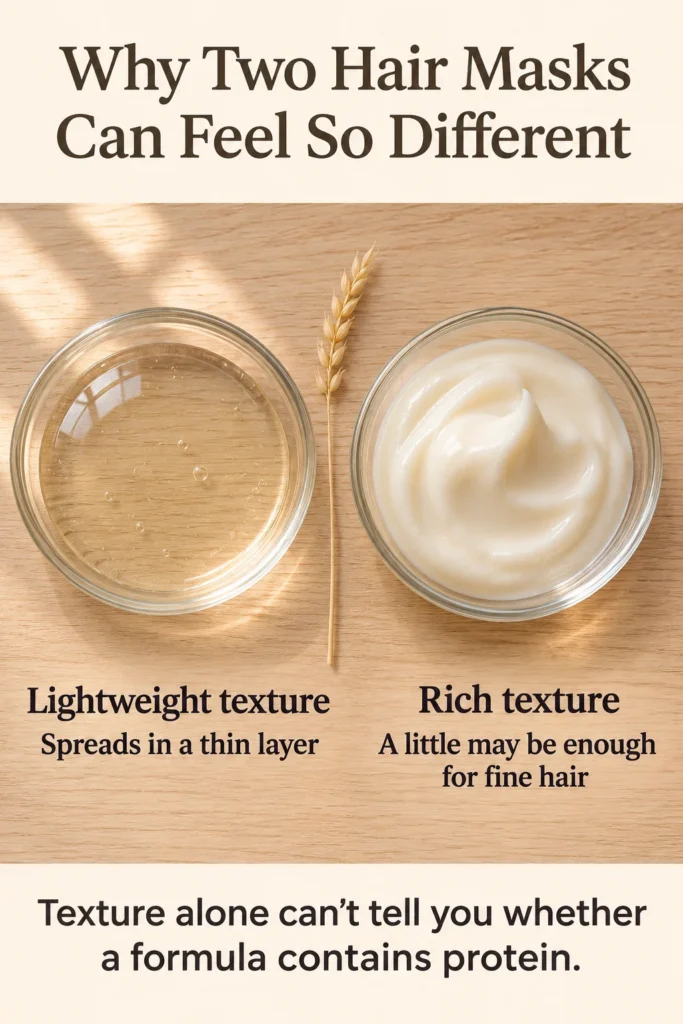
A fine strand is not a thin version of a thick strand. The proportions inside it are different, and that is the reason protein vs moisture for fine hair is a different question than it is for anyone else.
Every hair has an outer cuticle layer and an inner cortex. Thick hair has a large cortex, so there is plenty of interior to absorb a conditioning treatment. Fine hair has much less cortex relative to its surface, which means a treatment that penetrates a coarse strand mostly sits on the outside of a fine one.
Anything sitting on the outside is weight. That is the whole reason a mask that leaves your friend with glossy bouncy hair leaves yours flat by Tuesday.
Molecular weight is the part nobody mentions on the bottle
Conditioning ingredients differ enormously in the size of their molecules, and size decides whether something gets inside the strand or stays on top of it.
Hydrolyzed proteins are a good example. Hydrolyzing means breaking a large protein into smaller fragments, and the smaller fragments can move into the hair while the large ones cannot. This is why a label saying hydrolyzed silk or hydrolyzed rice protein behaves differently from one saying keratin, and why the cosmetic chemistry reviews of hair conditioning agents spend so much time on molecular size.
Oils follow the same logic. A published comparison of coconut, sunflower and mineral oils found coconut oil reduced protein loss from hair where the others did not, and part of the reason is that its molecules are small and straight enough to move into the strand rather than coating it. Shea butter and castor oil are a different proposition entirely: heavy, large, and designed to sit on the surface.
Small molecules. Hydrolyzed proteins, amino acids, panthenol, lighter oils. These can get into the strand, so they do something without much weight penalty.
Large molecules. Whole keratin, raw butters, heavy plant oils, thick silicones. These coat. On coarse hair that coating is welcome, on fine hair it is a gravity trap.
What this means in practice. You are not avoiding protein or moisture. You are avoiding the heavy versions of both.
Worth noting that penetration research is mostly done on specific ingredients under lab conditions, so treat this as a useful rule of thumb rather than a precise prediction for every product on the shelf.
What Each Kind of Overload Actually Looks Like in the Mirror

Both states feel like damage, which is why people so often treat one with the other and make it worse. The signs are quite distinct once you know them.
Protein overload on fine hair
Monday morning your hair feels dry no matter how much conditioner you used. It has a straw like, slightly squeaky quality. It will not hold a curl, and it will not lie down either.
You notice short broken pieces around your part line and at your crown. The ends look frayed even though you had a trim recently. Brushing produces a dry rasping sound rather than a smooth glide.
This is what people mean by protein overload on fine hair. Too much protein leaves the strand rigid, and rigid hair has no give, so normal handling snaps it. If you have been using a strengthening shampoo, a protein conditioner and a bond building treatment in the same week, that is usually the culprit.
Moisture overload on thin hair
The opposite picture. Your hair feels soft, almost too soft, and limp from the roots. It has no body, holds no shape, and separates into stringy pieces when it dries.
Wet, it stretches alarmingly and feels slippery and elastic. It tangles in soft mushy knots rather than dry crunchy ones. You might find it looks greasy by the second day even though your scalp is not especially oily, because the product sitting on the hair is picking up the light the way oil does.
Moisture overload on thin hair is common because the symptoms of dryness and the symptoms of overload both read as “my hair needs help,” and the instinctive response to both is another mask.
A word about the swelling problem
You will see the term hygral fatigue used in hair forums for what happens when hair is repeatedly soaked and dried. The underlying mechanism is real and documented: water makes the hair shaft swell, drying makes it contract, and repeated cycles of that put stress on the cuticle.
The term itself is community vocabulary rather than established clinical terminology, so take the label loosely while taking the mechanism seriously. For fine hair the practical takeaway is simple. Long soaking treatments and very frequent deep conditioning are not automatically better, and may be doing the opposite of what you want.
What to Look For on the Label and What to Walk Past
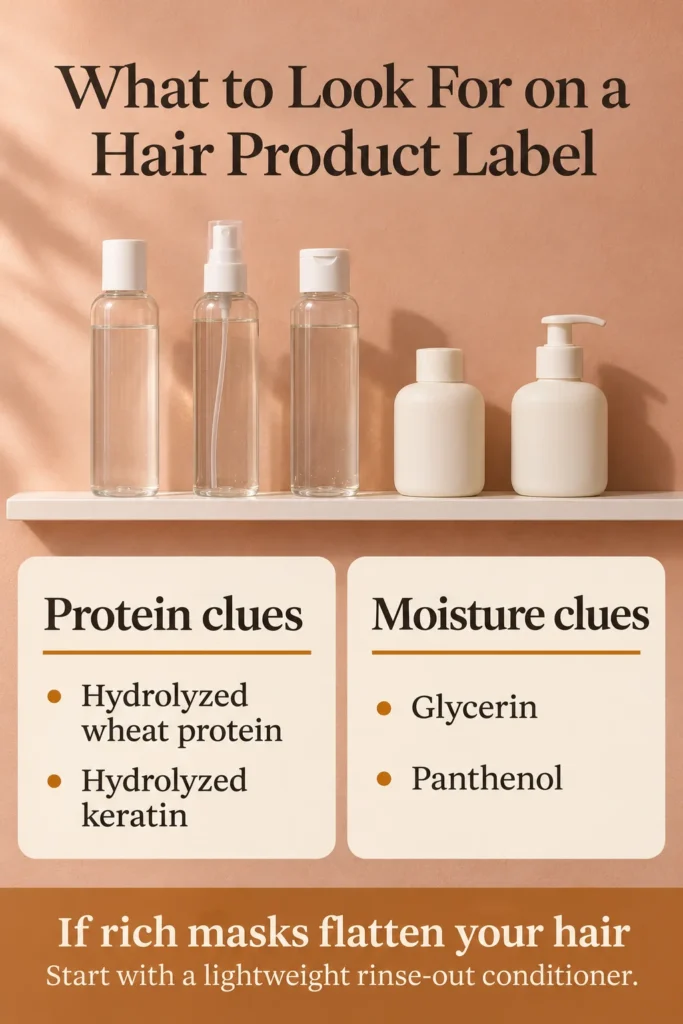
You do not need to memorize cosmetic chemistry. Getting protein vs moisture for fine hair right mostly comes down to recognizing about ten words on a label.
Lightweight protein, worth looking for. Hydrolyzed silk protein, hydrolyzed rice protein, hydrolyzed wheat protein, and amino acids such as arginine or cysteine. These are the fragmented, smaller versions, which is what makes them suitable as lightweight protein for fine hair.
Lightweight moisture, worth looking for. Panthenol, also listed as pro vitamin B5, which is well established as a conditioning humectant. Glycerin in modest amounts. Aloe vera. Sodium hyaluronate, the smaller form of hyaluronic acid, which holds water without much weight, though the evidence on hair specifically is thinner than the marketing suggests.
Heavy, usually worth skipping. Shea butter, cocoa butter, castor oil, mineral oil high in the list, and the heavier silicones such as dimethicone when it appears near the top. None of these are bad ingredients. They are simply built for hair with more cortex than yours.
Position in the ingredient list matters as much as presence. An ingredient in the last third of the list is there in a small amount. The same ingredient in the first five is doing most of the work in that bottle.
One thing to avoid entirely is the sweeping ban. Silicones are not universally bad for fine hair, and a light one such as cyclopentasiloxane can give you slip with almost no weight. The question is always the specific ingredient and how much of it, not the category.
Building a Wash Day That Does Not Flatten You
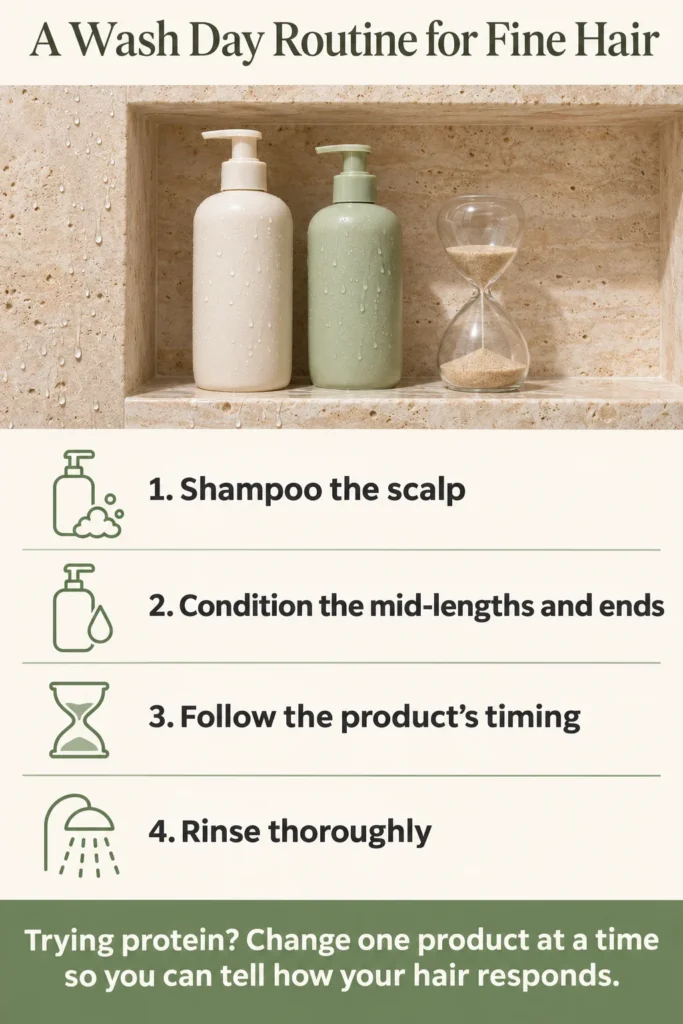
Rotation beats routine here, because your hair does not need the same thing every week. The balance of protein vs moisture for fine hair shifts with heat, color and even the season.
The short mask rule
Fine hair does not need twenty minutes under a towel. Three to five minutes is usually enough for a lightweight treatment, which some people call flash masking, though it is really just a short mask with the time dialed down to suit the hair.
The logic is straightforward. A small cortex reaches saturation quickly, so the extra fifteen minutes is not adding benefit, it is adding product that has to be rinsed out and will leave residue if it is not.
A workable rotation
Wash one. Lightweight protein treatment, three to five minutes, mid lengths and ends only. Nothing at the roots.
Wash two. Light moisture. A rinse out conditioner is often enough, no mask needed.
Wash three. Nothing beyond shampoo and a quick conditioner on the ends. This is the reset wash and it matters more than people expect.
Then repeat, adjusting by feel. Retest a strand every few weeks and shift the balance toward whichever side the test points to.
Keep everything three inches down from the scalp. Roots need nothing but clean, and product at the root is the single fastest way to lose the volume you are trying to protect. Our volume and thickness guides go into the root level work in more detail.
Washing frequency is personal and there is no universal number. What matters is that you are not stacking treatments between washes.
The Habits That Quietly Flatten Fine Hair

Treating every bad hair day as dryness. Half the time it is the opposite, and another mask makes it worse. Pull a strand before you reach for anything.
Stacking products from the same family. A strengthening shampoo plus a protein conditioner plus a bond treatment is three doses of the same thing in one wash.
Leaving masks on far longer than directed. Longer is not stronger, and on fine hair it mostly means more to rinse out.
Applying anything at the roots. Conditioner, oil, leave in, mask. All of it belongs below the ears.
Switching products every two weeks. You cannot read a result you never gave time to appear. Four washes is a fair trial.
If your hair is breaking in a way that worries you, or your scalp is sore, flaking or itchy over weeks rather than days, that is a conversation with a dermatologist rather than a product problem. And if the ends are the issue regardless of what you put on them, the cut may be working against you. Our haircuts for fine hair guides explain why a blunt perimeter holds up better than heavily thinned ends.
Questions People Actually Ask
How often does fine hair need protein?
Roughly every second or third wash is a reasonable starting point, using a lightweight treatment for three to five minutes. If your hair starts feeling stiff or rough, space it out. If it feels limp and overstretched, bring it closer together. The strand test is more useful here than any fixed schedule, since chemically treated or heat styled hair uses protein up faster than untouched hair.
Can I use protein and moisture in the same wash?
Yes, and for a lot of people it works well. Use the protein treatment first on mid lengths and ends, rinse it properly, then follow with a light conditioner. What causes trouble is doing both as heavy masks, or applying either one at the roots. If you only have time for one, pick based on how the strand behaved when you pulled it.
Why does my fine hair feel dry and limp at the same time?
That combination usually points to buildup rather than a genuine shortage of either. Product sitting on the outside of the strand blocks moisture from getting in, so the hair feels dry, while the coating itself adds weight so it also feels limp. A clarifying wash often resolves it, after which you can retest the strand and see what you are really working with.
Is a bond building treatment the same as a protein treatment?
No, although they get shelved together. Protein treatments deposit material onto or into the strand to add temporary structure. Bond builders are marketed as repairing specific chemical links inside the hair, and they are not meant to be layered on top of a protein product in the same wash. Using both in one week is one of the more common routes to stiff, snappy fine hair.
Quick Reference for Protein vs Moisture for Fine Hair
| Sign | Likely cause | What to reach for |
|---|---|---|
| Wet strand stretches a long way, feels gummy | Not enough protein | Lightweight hydrolyzed protein, 3 to 5 minutes |
| Wet strand snaps almost at once, feels rough | Not enough moisture | Panthenol or aloe based conditioner, light application |
| Straw like, squeaky, will not hold a curl | Protein overload | Pause protein, use light moisture for two washes |
| Limp from the roots, soft but shapeless | Moisture overload | Pause masks, clarify once, then rebuild with protein |
| Dry and limp together | Buildup | Clarifying wash, then retest the strand |
| Fine and stretchy with no spring back | Heat or color damage | Lightweight protein more often, less heat |
Pull a strand this week before you buy anything else. Then pick one product, use it for four washes, and pay attention to how your hair feels rather than how it looks on day one.
Fine hair responds quickly once you stop treating it like coarse hair in a smaller quantity. Protein vs moisture for fine hair is a balance you keep adjusting rather than a setting you find once, so repeat the strand test every month or so rather than settling on a routine and defending it.