How to Backcomb Fine Hair Without Damage: The One-Way Technique
You can backcomb fine hair without wrecking it, and the difference comes down to one thing: which way the comb moves. Most damage happens because people saw the comb up and down at the roots like they are starting a fire.
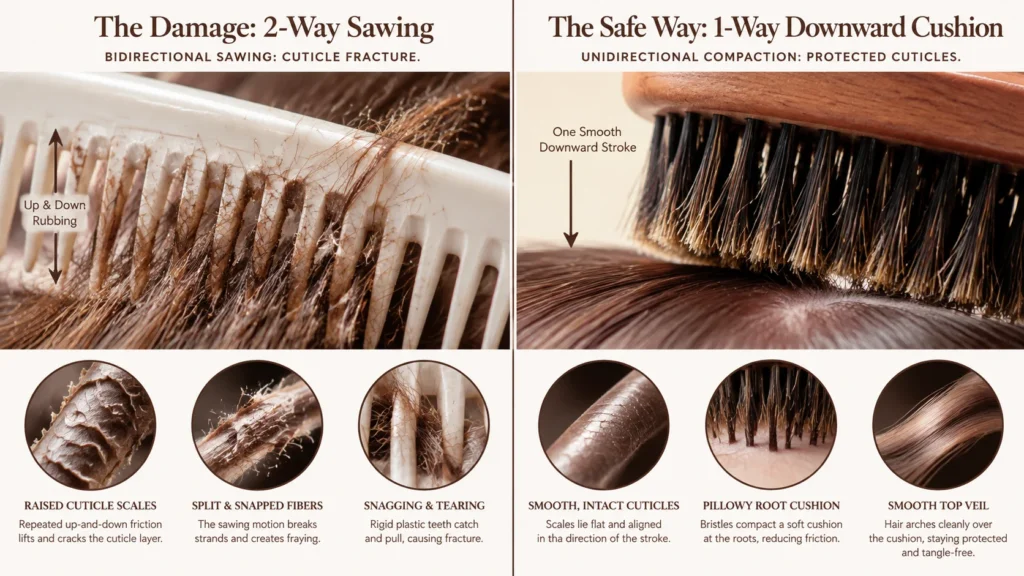
That back and forth motion is what ruins fine hair. Hair is covered in tiny overlapping scales, and dragging a comb against them repeatedly lifts those scales open and snaps fragile strands underneath.
Move the comb one way only, and you get the same lift with almost none of the damage. You are compacting hair into a soft cushion at the base rather than sawing through it.
Here is the method I use backstage, plus how to take it out at night without losing a handful of hair in the process.
The Safe Backcombing Rules
- One direction only. This single habit is what lets you backcomb fine hair safely. Push down toward the scalp, lift the comb out, start again. Never drag it back up through the section.
- Never tease bare hair. A puff of dry texture spray coats the strands so they slide against each other instead of grinding.
- Protect the canopy. Clip away a smooth half-inch veil from the top first. Dropped over the tease afterward, it hides everything.
- Tease the base, not the length. Only the bottom inch or so from the scalp. Teasing mid-lengths is what creates knots you cannot brush out.
How to Backcomb Fine Hair in 5 Steps
1. Separate the Canopy
Step 01 • Set up the veil
Take the top half-inch of hair either side of your part, comb it smooth, and clip it forward out of the way.
This layer never gets touched when you backcomb fine hair. When it drops back down at the end, it covers everything underneath, which is why nobody can tell you teased at all.
Tool or motion: Two sectioning clips and a comb
Common mistake: Teasing the surface layer, which then looks fluffy and obvious
Damage-free rule: Nothing on top of the head gets teased, ever
2. Prep with a Friction Shield
Step 02 • Build the buffer
Puff a little rice starch powder or a mist of dry texture spray at the roots of the section you are about to work on.
It sounds fussy and it takes five seconds. That coating is what lets you backcomb fine hair without the strands grinding their cuticles against each other.
Tool or motion: Dry texture spray or a light root powder
Common mistake: Teasing freshly washed, slippery hair with nothing on it
Damage-free rule: Never a comb on bare, clean roots
How well powders and sprays grip depends on your hair. Low porosity strands keep the grit sitting on the surface, while high porosity strands absorb it and go slippery again quickly. Our Hair Porosity Finder tells you which you are dealing with.
3. Hold at 90 Degrees
Step 03 • Get the tension right
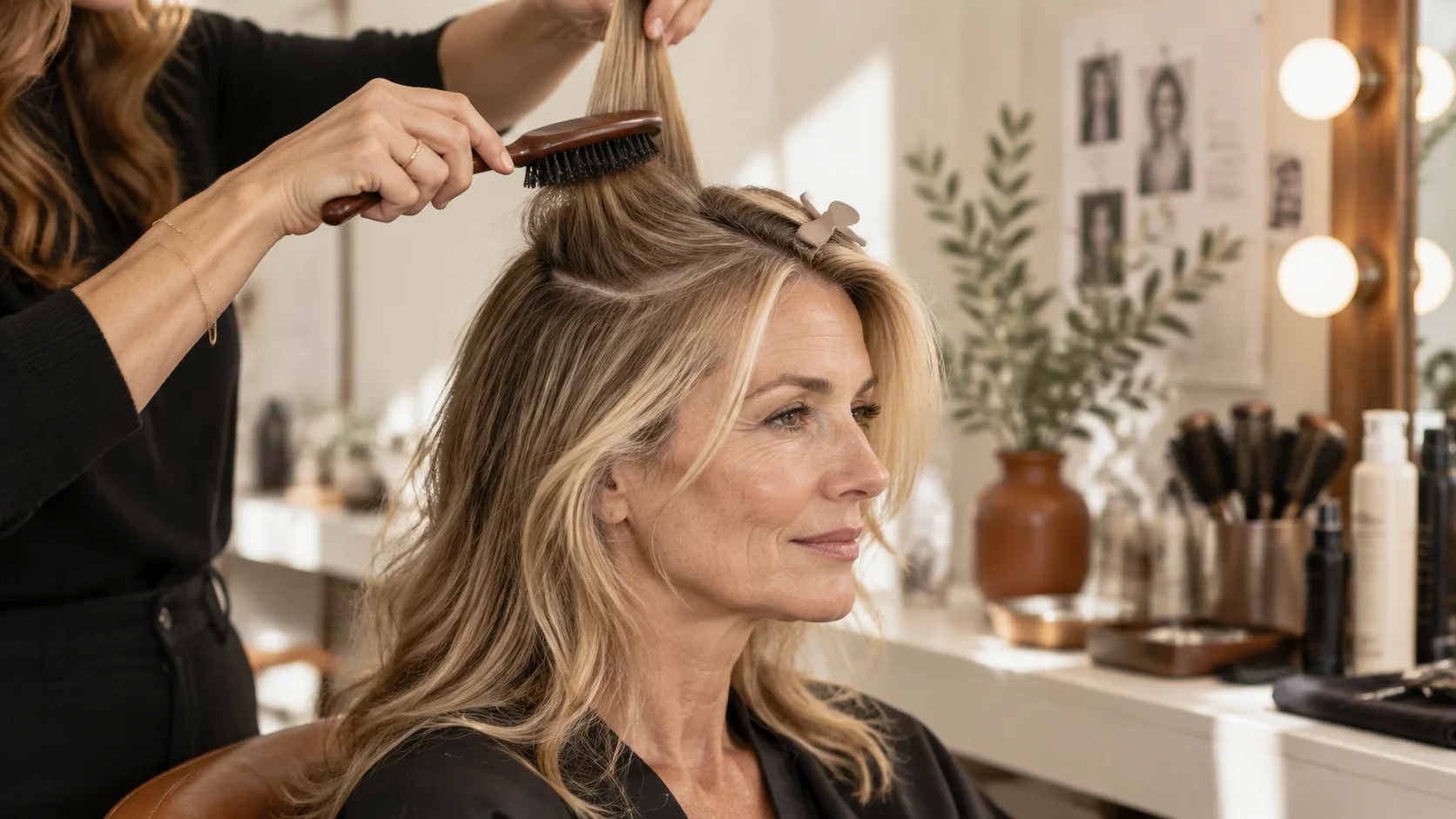
Take a section about two inches wide and hold it straight up from your scalp, taut, like a guitar string.
Slack hair buckles and knots when the comb meets it. Held tight, the strands have nowhere to bend, so they compact neatly instead of tangling.
Tool or motion: Your free hand, holding firmly but not pulling
Common mistake: Letting the section droop while you work
Damage-free rule: If your scalp feels any pull, you are holding too hard
4. Three Downward Strokes
Step 04 • The actual tease
Insert a teasing brush or carbon comb about two inches up the section, then push down smoothly to the base. Lift the comb all the way out, reposition, and repeat.
Three strokes per section is all it takes to backcomb fine hair properly. That is genuinely all you need, and stopping there is the main reason this method does not damage anything.
Tool or motion: Boar bristle teasing brush or a carbon tail comb
Common mistake: Sawing up and down, or doing ten strokes because three feels too few
Damage-free rule: Comb comes out of the hair between every stroke
5. Drop the Veil and Smooth
Step 05 • The finish
Unclip the canopy, let it fall over the cushion, and smooth just the surface with a boar bristle brush using light, gentle strokes.
Smooth only the top. If your brush sinks into the teased section underneath, you will pull the whole thing apart.
Tool or motion: Soft boar bristle brush, surface only
Common mistake: Brushing hard enough to reach the cushion underneath
Damage-free rule: Light hands, and mist with hairspray from ten inches away
How to Take It Out at Night Without Snapping Anything
This is where most of the breakage actually happens, not while you backcomb fine hair. Never drag a brush straight down through a teased crown.
Put one drop of light oil on your fingertips and massage the base of the cushion gently, working the compacted hair loose from underneath. Then use a wide-tooth comb from the ends upward, taking small sections at a time.
If you meet resistance, stop and go back to your fingers. Forcing a comb through a tease is exactly the kind of pulling that research on hair breakage during combing links to snapped strands.
Tools That Protect, and Tools That Rip
Worth owning to backcomb fine hair: a natural boar bristle teasing brush, which grips hair and compacts it without cutting into the cuticle, and a carbon tail comb with multiple tooth lengths. Both are gentle enough to use weekly.
Leave in the drawer: cheap plastic combs with a molded seam down each tooth, and metal rat-tail combs used with any force. Run your thumbnail along the teeth of any comb you own. If you feel a ridge, that ridge is scraping your hair every stroke.
Frequently Asked Questions
Is a boar bristle brush better than a comb for teasing?
To backcomb fine hair, usually yes. The bristles are soft enough to compact hair without digging into the cuticle, and they spread the work over a wider area. A carbon comb gives you more precision at the roots, so plenty of stylists keep both and use the comb only at the very base.
Can backcombing cause permanent hair loss?
No. When you backcomb fine hair occasionally and gently, it does not. What causes trouble is daily aggressive ratting combined with tight styles, which puts steady tension on the follicles. The American Academy of Dermatology advises being gentle with thinning hair for that reason. Tease for events and busy days rather than every single morning.
Why does my teased crown collapse by midday?
Usually because there was no grit in the hair to hold the cushion when you backcombed fine hair, or because it was teased on very clean, slippery strands. Add texture spray first, and finish with a light mist of hairspray over the smoothed canopy rather than into the tease itself.
What do I do if the tease knots up?
Do not pull. Saturate the knot with conditioner or a detangling spray, hold the hair above it so your scalp takes no strain, and tease it apart with your fingertips from the outer edge inward. Knots almost always give way to patience and slip.
The less lift you have to build by hand, the less you need to backcomb fine hair at all. A proper root-drying routine does half the work for you, and our volume and thickness guides walk through it. A blunt baseline helps too, since a teased crown looks balanced above solid ends rather than wispy ones, which is covered in our haircuts for fine hair guides.
Final Thoughts
Fine hair does not have to stay flat, and it does not have to be destroyed to get some height either. Precision beats force every time you backcomb fine hair.
One direction, three strokes, a veil on top, and oil at night to take it down. Do it that way and you can backcomb fine hair for years without leaving a trace.